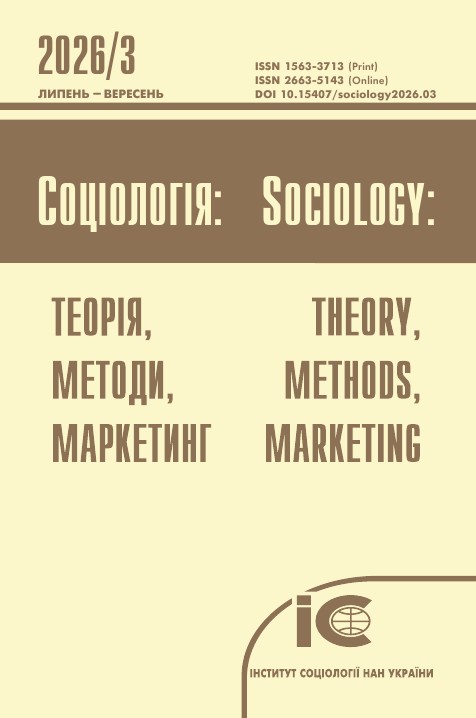
Scientific Journal "Sociology: Theory, Methods, Marketing"
LATEST PRINTED ISSUE
LATEST FREELY ACCESSIBLE MATERIALS
The interdependence of return and psychosocial well-being of forced migrants: foreign approaches and the Ukrainian dimension
stmm. 2026 (3): 96-122
DOI https://doi.org/10.15407/sociology2026.03.096
Full text: https://stmm.in.ua/archive/ukr/2026-3/8.pdf
VOLODYMYR HNATIUK, PhD in Political Science, Research Fellow at the International Institute of Education, Culture and Relations with Diaspora, Lviv Polytechnic National University (12, Stepana Bandery St., Lviv, 79013)
v.v.hnatiuk@gmail.com
https://orcid.org/0000-0002-2608-659X
SCOPUS ID: 57214889239
The article examines the complex and ambiguous dynamics of the relationship between return migration and the psychosocial wellbeing of forced migrants, focusing on Ukrainians within the context of the full-scale Russian-Ukrainian war. It is emphasised that traditional macroeconomic and state-centred approaches, which view return migration as a natural conclusion of the migratory cycle and an unconditional benefit, are conceptually inadequate and necessitate alternative supplementation. A review of Ukrainian researchers’ works reveals that the study of the psychosocial dimension of return is at an emerging stage, with existing scholarship focusing predominantly on migration intentions and general security factors. By synthesising contemporary approaches of international scholars, the article develops an analytical framework that proposes a model for conceptualising return migration as a turbulent, multidimensional, and non-linear process. It is argued that the success of return is determined not by the mere physical crossing of borders, but by an individual’s capacity to overcome “reverse culture shock”, leverage transnational experience, and restore a level of psychosocial wellbeing and agency that is above satisfactory. The article examines the influence of intersectional “filters” — namely spatial mobility, gender, and age — on the final decision to return. Furthermore, it is stressed that for Ukrainians, return migration frequently occurs under conditions of constrained voluntariness, manifesting as an “illusion of choice”. The article substantiates the view that state neglect of migrants’ psychosocial wellbeing and the absence of specialised intangible support mechanisms — against the backdrop of an exhausted host society — can transform return into a catalyst for systemic social tension and marginalisation. Ultimately, it is argued that the application of this analytical framework opens new horizons for Ukrainian scholarship and the formulation of effective post-war reconstruction policies.
Keywords: return migration; psychosocial wellbeing; Ukrainian forced migrants; voluntariness; contextuality
References:
-
Artiomov, I. & Liashko, M. (2024). Return of migrants - an issue of national security of Ukraine. [In Ukrainian]. Heopolityka Ukrainy: Istoriia i Suchasnist, 2(33), 9-25.
-
Barrett, A. & Mosca, I. (2013). Social isolation, loneliness and return migration: Evidence from older Irish adults. Journal of Ethnic and Migration Studies, 39(10), 1659-1677. https://doi.org/10.1080/1369183X.2013.833694
-
Bendixsen, S. & Lidén, H. (2017). Return to wellbeing? Irregular migrants and assisted return in Norway. In: Z. Vathi & R. King (Eds.), Return migration and psychosocial wellbeing: Discourses, policy-making and outcomes for migrants and their families (pp. 21-38). Routledge. https://doi.org/10.4324/9781315619613-2
-
Bhugra, D. (2004). Migration and mental health. Acta Psychiatrica Scandinavica, 109(4), 243-258. https://doi.org/10.1046/j.0001-690X.2003.00246.x
-
Black, R. & Gent, S. (2004). Defining, measuring and influencing sustainable return: The case of the Balkans (Migration Working Paper T7). University of Sussex, Development Research Centre on Migration, Globalisation and Poverty.
-
Blitz, B., Sales, R., & Marzano, L. (2005). Non-voluntary return? The politics of return to Afghanistan. Political Studies, 53(1), 182-200. https://doi.org/10.1111/j.1467-9248.2005.00523.x
-
Boccagni, P. & Baldassar, L. (2015). Emotions on the move: Mapping the emergent field of emotion and migration. Emotion, Space and Society, 16, 73-80. https://doi.org/10.1016/j.emospa.2015.06.009
-
Cassarino, J.-P. (2004). Theorising return migration: The conceptual approach to return migrants revisited. International Journal on Multicultural Societies, 6(2), 253-279.
-
Cassarino, J.-P. (2008). Conditions of modern return migrants. International Journal on Multicultural Societies, 10(2), 95-105.
-
Cedos. (2022). Forced migration and war in Ukraine. Retrieved from: https://cedos.org.ua/en/researches/forced-migration-and-war-in-ukraine-march-24-june-10-2022/
-
Cela, E. (2017). Migration and return migration in later life to Albania: The pendulum between subjective wellbeing and place. In: Z. Vathi & R. King (Eds.), Return migration and psychosocial wellbeing: Discourses, policy-making and outcomes for migrants and their families (pp. 203-220). Routledge. https://doi.org/10.4324/9781315619613-12
-
Cresswell, T. (2006). On the move: Mobility in the modern Western world. Routledge.
-
de Haas, H. (2023). How migration really works: The facts about the most divisive issue in politics. Basic Books.
-
de Haas, H., Castles, S., & Miller, M. (2020 [1993]). The age of migration: International population movements in the modern world (6th ed.). Guilford Press.
-
DeBono, D. (2017). 'Burning without fire' in Sweden: The paradox of the state's attempt to safeguard deportees' psychosocial wellbeing. In: Z. Vathi & R. King (Eds.), Return migration and psychosocial wellbeing: Discourses, policy-making and outcomes for migrants and their families (pp. 129-148). Routledge. https://doi.org/10.4324/9781315619613-8
-
Dodge, R., Daly, A., Huyton, J., & Sanders, L. (2012). The challenge of defining wellbeing. International Journal of Wellbeing, 2(3), 222-235. https://doi.org/10.5502/ijw.v2i3.4
-
Elder, G.H, Jr. (1994). Time, human agency, and social change: Perspective on the life course. Social Psychology Quarterly, 57(1), 4-15. https://doi.org/10.2307/2786971
-
Erdal, M. & Oeppen, C. (2017). Forced to return? Agency and the role of post-return mobility for psychosocial wellbeing among returnees to Afghanistan, Pakistan and Poland. In: Z. Vathi & R. King (Eds.), Return migration and psychosocial wellbeing: Discourses, policy-making and outcomes for migrants and their families (pp. 39-55). Routledge. https://doi.org/10.4324/9781315619613-3
-
Gmelch, G. (1980). Return migration. Annual Review of Anthropology, 9, 135-159. https://doi.org/10.1146/annurev.an.09.100180.001031
-
Gońda, M. (2017). Roots migration to the ancestral homeland and psychosocial wellbeing: Young Polish diasporic students. In: Z. Vathi & R. King (Eds.), Return migration and psychosocial wellbeing: Discourses, policy-making and outcomes for migrants and their families (pp. 75-92). Routledge. https://doi.org/10.4324/9781315619613-5
-
Gough, I. & McGregor, J. (Eds.). (2007). Wellbeing in developing countries. Cambridge University Press. https://doi.org/10.1017/CBO9780511488986
-
Granovetter, M. (1985). Economic Action and Social Structure: The Problem of Embeddedness. American Journal of Sociology, 91(3), 481-510. https://doi.org/10.1086/228311
-
Gray, B. (2008). Putting emotion and reflexivity to work in researching migration. Sociology, 42(6), 935-952. https://doi.org/10.1177/0038038508094571
-
Hall, K., Betty, C., & Giner, J. (2017). To stay or to go? The motivations and experiences of older British returnees from Spain. In: Z. Vathi & R. King (Eds.), Return migration and psychosocial wellbeing: Discourses, policy-making and outcomes for migrants and their families (pp. 221-239). Routledge. https://doi.org/10.4324/9781315619613-13
-
Huot, S., Dodson, B., & Rudman, D. (2014). Negotiating belonging following migration: Exploring the relationship between place and identity in Francophone minority communities. The Canadian Geographer, 58(3), 329-340. https://doi.org/10.1111/cag.12067
-
IOM. (2024). Ukraine returns report: General population survey. Retrieved from: https://dtm.iom.int/reports/ukraine-returns-report-general-population-survey
-
IOM. (2026). Ukraine - Returns report - General population survey round 23 (May 2026). Retrieved from: https://dtm.iom.int/reports/ukraine-returns-report-general-population-survey-round-23-may-2026
-
Janzen, J. (2004). Illusions of home in the story of a Rwandan refugee's return. In: L. Long & E. Oxfeld (Eds.), Homecomings: Refugees, migrants, and those who stayed behind (pp. 19-33). University of Pennsylvania Press. https://doi.org/10.9783/9781512821659-002
-
Jauhiainen, J. (2026a). From Ukraine to the European Union and back: Ukrainians return migration and reintegration. Routledge. https://doi.org/10.4324/9781003653745
-
Jauhiainen, J. (2026b). Reintegration of War-Fleeing Ukrainians After Their Return to Ukraine. International Migration, 1(64), e70124. https://doi.org/10.1111/imig.70124
-
Kabanets, Yu., Khelashvili, A., Budz, O., Miloserdov, V., Voitenko, O., & Polishchuk, O. (2025). Experience of forced displacement abroad and thoughts on returning to Ukraine: Research report. [In Ukrainian]. Cedos Think Tank. Retrieved from: https://cedos.org.ua/wp-content/uploads/dosvid-vymushenogo-peremishhennya-za-kordon-ta-dumky-pro-povernennya-v-ukrayinu.pdf
-
Kalir, B. (2017). Between 'voluntary' return programs and soft deportation: Sending vulnerable migrants in Spain back 'home'. In: Z. Vathi & R. King (Eds.), Return migration and psychosocial wellbeing: Discourses, policy-making and outcomes for migrants and their families (pp. 56-71). Routledge. https://doi.org/10.4324/9781315619613-4
-
Kulu, H. & Milewski, N. (2007). Family change and migration in the life course: An introduction. Demographic Research, 17(19), 567-590. https://doi.org/10.4054/DemRes.2007.17.19
-
Levitt, P. & Glick Schiller, N. (2004). Conceptualizing simultaneity: A transnational social field perspective on society. International Migration Review, 38(3), 1002-1039. https://doi.org/10.1111/j.1747-7379.2004.tb00227.x
-
Libanova, E., Pozniak, O., & Tsymbal, O. (2022). Scales and consequences of the forced migration of Ukraine's population as a result of the armed aggression of the Russian Federation. [In Ukrainian]. Demohrafiia ta Sotsialna Ekonomika, 2(48), 37-57. https://doi.org/10.15407/dse2022.02.037
-
Lietaert, I., Broekaert, E., & Derluyn, I. (2017). Time heals? A multi-sited, longitudinal case study on the lived experiences of returnees in Armenia. In: Z. Vathi & R. King (Eds.), Return migration and psychosocial wellbeing: Discourses, policy-making and outcomes for migrants and their families (pp. 165-181). Routledge. https://doi.org/10.4324/9781315619613-10
-
Majidi, N. (2017). The return of refugees from Kenya to Somalia: Gender and psychosocial wellbeing. In: Z. Vathi & R. King (Eds.), Return migration and psychosocial wellbeing: Discourses, policy-making and outcomes for migrants and their families (pp. 149-164). Routledge. https://doi.org/10.4324/9781315619613-9
-
Malkki, L. (1995). Refugees and exile: From 'refugee studies' to the national order of things. Annual Review of Anthropology, 24, 495-523. https://doi.org/10.1146/annurev.an.24.100195.002431
-
McAuliffe, M. & Oucho, L. (Eds.). (2024). World migration report 2024. International Organization for Migration. https://doi.org/10.1002/wom3.36
-
Medvedieva, O. (2023). Empirical study of the features of social and psychological wellbeing of forced migrants. [In Ukrainian]. Habitus, 46, 188-192. https://doi.org/10.32782/2663-5208.2023.46.30
-
Miakyna, O., Sokol, K., Shevchenko, O., Vashchuk, M., & Shevchenko, O. (2025). Migrants of the Russian-Ukrainian war: Demographic and psychosocial consequences. [In Ukrainian]. Medytsyna siohodni i zavtra, 2(94), 109-116. https://doi.org/10.35339/msz.2025.94.2.mss
-
OECD. (2026). Ukraine's strategic response to the displacement crisis: Return, reintegrate, reconnect. OECD Publishing. https://doi.org/10.1787/9b773da4-en
-
Panok, V. (2023). Psychological research in wartime conditions: Problems and tasks. [In Ukrainian]. Visnyk NAPN Ukrainy, 1(5), 1-12.
-
Porobić, S. (2017). 'Invisible' returns of Bosnian refugees and their psychosocial wellbeing. In: Z. Vathi & R. King (Eds.), Return migration and psychosocial wellbeing: Discourses, policy-making and outcomes for migrants and their families (pp. 108-125). Routledge. https://doi.org/10.4324/9781315619613-7
-
Potapenko, V., Holovka, A., Valevskyi, O., & Drapushko, R. (2023). Impact of migration on the socio-economic situation in Ukraine: Analytical report (V. Potapenko, Ed.). [In Ukrainian]. National Institute for Strategic Studies.
-
Sampaio, D. (2017). 'Is this really where home is?' Experiences of home in a revisited homeland among ageing Azorean returnees. In: Z. Vathi & R. King (Eds.), Return migration and psychosocial wellbeing: Discourses, policy-making and outcomes for migrants and their families (pp. 240-256). Routledge. https://doi.org/10.4324/9781315619613-14
-
Sardinha, J. & Cairns, D. (2017). 'This country plays tricks on you': Portuguese migrant descendant returnees narrate economic crisis-influenced 'returns'. In: Z. Vathi & R. King (Eds.), Return migration and psychosocial wellbeing: Discourses, policy-making and outcomes for migrants and their families (pp. 93-107). Routledge. https://doi.org/10.4324/9781315619613-6
-
Schütz, A. (1945). The homecomer. American Journal of Sociology, 50(5), 369-376. https://doi.org/10.1086/219654
-
Soja, E. (1989). Postmodern Geographies: The Reassertion of Space in Critical Social Theory. Verso.
-
Song, C. (2009). Brothers only in name: The alienation and identity formation of Korean Chinese return migrants in South Korea. In: T. Tsuda (Ed.), Diasporic homecomings: Ethnic return migration in comparative perspective (pp. 281-304). Stanford University Press. https://doi.org/10.1515/9780804772068-012
-
Stefansson, A. (2004). Sarajevo suffering: Homecoming and the hierarchy of homeland hardship. In: F. Markowitz & A. Stefansson (Eds.), Homecoming: Unsettling paths of return (pp. 54-75). Lexington Books.
-
Stevens, G. & Vollebergh, W. (2008). Mental health in migrant children. Journal of Child Psychology and Psychiatry, 49(3), 276-294. https://doi.org/10.1111/j.1469-7610.2007.01848.x
-
Tkach, D. (2024). How to return Ukrainians to Ukraine: Economic, social, psychological and cultural factors. [In Ukrainian]. Vcheni zapysky Universytetu "KROK", 4(76), 277-286. https://doi.org/10.31732/2663-2209-2024-76-277-286
-
Tsuda, T. (2004). When home is not the homeland: The case of Japanese Brazilian ethnic return migration. In: F. Markowitz & A. Stefansson (Eds.), Homecomings: Unsettling paths of return (pp. 125-145). Lexington Books.
-
Tytarenko, T. (2024). My future depends on me: Practices of a healthy present in wartime and post-war conditions. Imeks-LTD. [In Ukrainian]. Retrieved from: https://ispp.org.ua/wp-content/uploads/2024/05/tytar-mono-24.pdf
-
UNHCR. (2024a). Lives on hold: Intentions and perspectives of refugees, refugee returnees and IDPs from Ukraine. Retrieved from: https://www.unhcr.org/ua/sites/ua/files/legacy-pdf/UNHCR-LIVES-ON-HOLD-5-INTENTIONS-OF-REF-REF-RETURNEES-AND-IDPS-FROM-UKR-SUMMARY-1.pdf
-
UNHCR. (2024b). Lives on hold 6: Intentions and perspectives of refugees, refugee returnees and internally displaced people from Ukraine. Retrieved from: https://www.unhcr.org/ua/sites/ua/files/2024-12/UNHCR%20-%20LIVES%20ON%20HOLD%206%20-%20INTENTIONS%20OF%20REF%2C%20REF%20RETURNEES%20AND%20IDPS%20FROM%20UKR%20%28SUMMARY%29_0.pdf
-
UNHCR. (2026, May 20). Ukraine refugee situation - Data explanatory note. Operational Data Portal. Retrieved from: https://data.unhcr.org/en/situations/ukraine
-
Urry, J. (2007). Mobilities. Polity.
-
Van Hear, N. (1998). New diasporas: The mass exodus, dispersal and regrouping of migrant communities. UCL Press.
-
Vathi, Z. (2017). Introduction: The interface between return migration and psychosocial wellbeing. In: Z. Vathi & R. King (Eds.), Return migration and psychosocial wellbeing: Discourses, policy-making and outcomes for migrants and their families (pp. 1-18). Routledge. https://doi.org/10.4324/9781315619613-1
-
Vathi, Z. & Duci, V. (2016). Making other dreams: The impact of migration on the psychosocial wellbeing of Albanian-origin children upon their families' return to Albania. Childhood, 23(1), 53-68. https://doi.org/10.1177/0907568214566078
-
Vathi, Z. & King, R. (Eds.). (2017). Return migration and psychosocial wellbeing: Discourses, policy-making and outcomes for migrants and their families. Routledge. https://doi.org/10.4324/9781315619613
-
Wright, K. (2012). Constructing human wellbeing across spatial boundaries: Negotiating meanings in transnational migration. Global Networks, 12(4), 467-484. https://doi.org/10.1111/j.1471-0374.2011.00341.x
- Yefimova, A. (2024). Adaptation of Ukrainians to forced migration: A study of psychosocial models and factors. Amazonia Investiga, 13(81), 130-141. https://doi.org/10.34069/AI/2024.81.09.10
Received 22.05.2026
Accepted for publication after review 08.07.2026
The interdependence of return and psychosocial well-being of forced migrants: foreign approaches and the Ukrainian dimension
stmm. 2026 (3): 96-122
DOI https://doi.org/10.15407/sociology2026.03.096
Full text: https://stmm.in.ua/archive/ukr/2026-3/8.pdf
VOLODYMYR HNATIUK, PhD in Political Science, Research Fellow at the International Institute of Education, Culture and Relations with Diaspora, Lviv Polytechnic National University (12, Stepana Bandery St., Lviv, 79013)
v.v.hnatiuk@gmail.com
https://orcid.org/0000-0002-2608-659X
SCOPUS ID: 57214889239
The article examines the complex and ambiguous dynamics of the relationship between return migration and the psychosocial wellbeing of forced migrants, focusing on Ukrainians within the context of the full-scale Russian-Ukrainian war. It is emphasised that traditional macroeconomic and state-centred approaches, which view return migration as a natural conclusion of the migratory cycle and an unconditional benefit, are conceptually inadequate and necessitate alternative supplementation. A review of Ukrainian researchers’ works reveals that the study of the psychosocial dimension of return is at an emerging stage, with existing scholarship focusing predominantly on migration intentions and general security factors. By synthesising contemporary approaches of international scholars, the article develops an analytical framework that proposes a model for conceptualising return migration as a turbulent, multidimensional, and non-linear process. It is argued that the success of return is determined not by the mere physical crossing of borders, but by an individual’s capacity to overcome “reverse culture shock”, leverage transnational experience, and restore a level of psychosocial wellbeing and agency that is above satisfactory. The article examines the influence of intersectional “filters” — namely spatial mobility, gender, and age — on the final decision to return. Furthermore, it is stressed that for Ukrainians, return migration frequently occurs under conditions of constrained voluntariness, manifesting as an “illusion of choice”. The article substantiates the view that state neglect of migrants’ psychosocial wellbeing and the absence of specialised intangible support mechanisms — against the backdrop of an exhausted host society — can transform return into a catalyst for systemic social tension and marginalisation. Ultimately, it is argued that the application of this analytical framework opens new horizons for Ukrainian scholarship and the formulation of effective post-war reconstruction policies.
Keywords: return migration; psychosocial wellbeing; Ukrainian forced migrants; voluntariness; contextuality
References:
-
Artiomov, I. & Liashko, M. (2024). Return of migrants - an issue of national security of Ukraine. [In Ukrainian]. Heopolityka Ukrainy: Istoriia i Suchasnist, 2(33), 9-25.
-
Barrett, A. & Mosca, I. (2013). Social isolation, loneliness and return migration: Evidence from older Irish adults. Journal of Ethnic and Migration Studies, 39(10), 1659-1677. https://doi.org/10.1080/1369183X.2013.833694
-
Bendixsen, S. & Lidén, H. (2017). Return to wellbeing? Irregular migrants and assisted return in Norway. In: Z. Vathi & R. King (Eds.), Return migration and psychosocial wellbeing: Discourses, policy-making and outcomes for migrants and their families (pp. 21-38). Routledge. https://doi.org/10.4324/9781315619613-2
-
Bhugra, D. (2004). Migration and mental health. Acta Psychiatrica Scandinavica, 109(4), 243-258. https://doi.org/10.1046/j.0001-690X.2003.00246.x
-
Black, R. & Gent, S. (2004). Defining, measuring and influencing sustainable return: The case of the Balkans (Migration Working Paper T7). University of Sussex, Development Research Centre on Migration, Globalisation and Poverty.
-
Blitz, B., Sales, R., & Marzano, L. (2005). Non-voluntary return? The politics of return to Afghanistan. Political Studies, 53(1), 182-200. https://doi.org/10.1111/j.1467-9248.2005.00523.x
-
Boccagni, P. & Baldassar, L. (2015). Emotions on the move: Mapping the emergent field of emotion and migration. Emotion, Space and Society, 16, 73-80. https://doi.org/10.1016/j.emospa.2015.06.009
-
Cassarino, J.-P. (2004). Theorising return migration: The conceptual approach to return migrants revisited. International Journal on Multicultural Societies, 6(2), 253-279.
-
Cassarino, J.-P. (2008). Conditions of modern return migrants. International Journal on Multicultural Societies, 10(2), 95-105.
-
Cedos. (2022). Forced migration and war in Ukraine. Retrieved from: https://cedos.org.ua/en/researches/forced-migration-and-war-in-ukraine-march-24-june-10-2022/
-
Cela, E. (2017). Migration and return migration in later life to Albania: The pendulum between subjective wellbeing and place. In: Z. Vathi & R. King (Eds.), Return migration and psychosocial wellbeing: Discourses, policy-making and outcomes for migrants and their families (pp. 203-220). Routledge. https://doi.org/10.4324/9781315619613-12
-
Cresswell, T. (2006). On the move: Mobility in the modern Western world. Routledge.
-
de Haas, H. (2023). How migration really works: The facts about the most divisive issue in politics. Basic Books.
-
de Haas, H., Castles, S., & Miller, M. (2020 [1993]). The age of migration: International population movements in the modern world (6th ed.). Guilford Press.
-
DeBono, D. (2017). 'Burning without fire' in Sweden: The paradox of the state's attempt to safeguard deportees' psychosocial wellbeing. In: Z. Vathi & R. King (Eds.), Return migration and psychosocial wellbeing: Discourses, policy-making and outcomes for migrants and their families (pp. 129-148). Routledge. https://doi.org/10.4324/9781315619613-8
-
Dodge, R., Daly, A., Huyton, J., & Sanders, L. (2012). The challenge of defining wellbeing. International Journal of Wellbeing, 2(3), 222-235. https://doi.org/10.5502/ijw.v2i3.4
-
Elder, G.H, Jr. (1994). Time, human agency, and social change: Perspective on the life course. Social Psychology Quarterly, 57(1), 4-15. https://doi.org/10.2307/2786971
-
Erdal, M. & Oeppen, C. (2017). Forced to return? Agency and the role of post-return mobility for psychosocial wellbeing among returnees to Afghanistan, Pakistan and Poland. In: Z. Vathi & R. King (Eds.), Return migration and psychosocial wellbeing: Discourses, policy-making and outcomes for migrants and their families (pp. 39-55). Routledge. https://doi.org/10.4324/9781315619613-3
-
Gmelch, G. (1980). Return migration. Annual Review of Anthropology, 9, 135-159. https://doi.org/10.1146/annurev.an.09.100180.001031
-
Gońda, M. (2017). Roots migration to the ancestral homeland and psychosocial wellbeing: Young Polish diasporic students. In: Z. Vathi & R. King (Eds.), Return migration and psychosocial wellbeing: Discourses, policy-making and outcomes for migrants and their families (pp. 75-92). Routledge. https://doi.org/10.4324/9781315619613-5
-
Gough, I. & McGregor, J. (Eds.). (2007). Wellbeing in developing countries. Cambridge University Press. https://doi.org/10.1017/CBO9780511488986
-
Granovetter, M. (1985). Economic Action and Social Structure: The Problem of Embeddedness. American Journal of Sociology, 91(3), 481-510. https://doi.org/10.1086/228311
-
Gray, B. (2008). Putting emotion and reflexivity to work in researching migration. Sociology, 42(6), 935-952. https://doi.org/10.1177/0038038508094571
-
Hall, K., Betty, C., & Giner, J. (2017). To stay or to go? The motivations and experiences of older British returnees from Spain. In: Z. Vathi & R. King (Eds.), Return migration and psychosocial wellbeing: Discourses, policy-making and outcomes for migrants and their families (pp. 221-239). Routledge. https://doi.org/10.4324/9781315619613-13
-
Huot, S., Dodson, B., & Rudman, D. (2014). Negotiating belonging following migration: Exploring the relationship between place and identity in Francophone minority communities. The Canadian Geographer, 58(3), 329-340. https://doi.org/10.1111/cag.12067
-
IOM. (2024). Ukraine returns report: General population survey. Retrieved from: https://dtm.iom.int/reports/ukraine-returns-report-general-population-survey
-
IOM. (2026). Ukraine - Returns report - General population survey round 23 (May 2026). Retrieved from: https://dtm.iom.int/reports/ukraine-returns-report-general-population-survey-round-23-may-2026
-
Janzen, J. (2004). Illusions of home in the story of a Rwandan refugee's return. In: L. Long & E. Oxfeld (Eds.), Homecomings: Refugees, migrants, and those who stayed behind (pp. 19-33). University of Pennsylvania Press. https://doi.org/10.9783/9781512821659-002
-
Jauhiainen, J. (2026a). From Ukraine to the European Union and back: Ukrainians return migration and reintegration. Routledge. https://doi.org/10.4324/9781003653745
-
Jauhiainen, J. (2026b). Reintegration of War-Fleeing Ukrainians After Their Return to Ukraine. International Migration, 1(64), e70124. https://doi.org/10.1111/imig.70124
-
Kabanets, Yu., Khelashvili, A., Budz, O., Miloserdov, V., Voitenko, O., & Polishchuk, O. (2025). Experience of forced displacement abroad and thoughts on returning to Ukraine: Research report. [In Ukrainian]. Cedos Think Tank. Retrieved from: https://cedos.org.ua/wp-content/uploads/dosvid-vymushenogo-peremishhennya-za-kordon-ta-dumky-pro-povernennya-v-ukrayinu.pdf
-
Kalir, B. (2017). Between 'voluntary' return programs and soft deportation: Sending vulnerable migrants in Spain back 'home'. In: Z. Vathi & R. King (Eds.), Return migration and psychosocial wellbeing: Discourses, policy-making and outcomes for migrants and their families (pp. 56-71). Routledge. https://doi.org/10.4324/9781315619613-4
-
Kulu, H. & Milewski, N. (2007). Family change and migration in the life course: An introduction. Demographic Research, 17(19), 567-590. https://doi.org/10.4054/DemRes.2007.17.19
-
Levitt, P. & Glick Schiller, N. (2004). Conceptualizing simultaneity: A transnational social field perspective on society. International Migration Review, 38(3), 1002-1039. https://doi.org/10.1111/j.1747-7379.2004.tb00227.x
-
Libanova, E., Pozniak, O., & Tsymbal, O. (2022). Scales and consequences of the forced migration of Ukraine's population as a result of the armed aggression of the Russian Federation. [In Ukrainian]. Demohrafiia ta Sotsialna Ekonomika, 2(48), 37-57. https://doi.org/10.15407/dse2022.02.037
-
Lietaert, I., Broekaert, E., & Derluyn, I. (2017). Time heals? A multi-sited, longitudinal case study on the lived experiences of returnees in Armenia. In: Z. Vathi & R. King (Eds.), Return migration and psychosocial wellbeing: Discourses, policy-making and outcomes for migrants and their families (pp. 165-181). Routledge. https://doi.org/10.4324/9781315619613-10
-
Majidi, N. (2017). The return of refugees from Kenya to Somalia: Gender and psychosocial wellbeing. In: Z. Vathi & R. King (Eds.), Return migration and psychosocial wellbeing: Discourses, policy-making and outcomes for migrants and their families (pp. 149-164). Routledge. https://doi.org/10.4324/9781315619613-9
-
Malkki, L. (1995). Refugees and exile: From 'refugee studies' to the national order of things. Annual Review of Anthropology, 24, 495-523. https://doi.org/10.1146/annurev.an.24.100195.002431
-
McAuliffe, M. & Oucho, L. (Eds.). (2024). World migration report 2024. International Organization for Migration. https://doi.org/10.1002/wom3.36
-
Medvedieva, O. (2023). Empirical study of the features of social and psychological wellbeing of forced migrants. [In Ukrainian]. Habitus, 46, 188-192. https://doi.org/10.32782/2663-5208.2023.46.30
-
Miakyna, O., Sokol, K., Shevchenko, O., Vashchuk, M., & Shevchenko, O. (2025). Migrants of the Russian-Ukrainian war: Demographic and psychosocial consequences. [In Ukrainian]. Medytsyna siohodni i zavtra, 2(94), 109-116. https://doi.org/10.35339/msz.2025.94.2.mss
-
OECD. (2026). Ukraine's strategic response to the displacement crisis: Return, reintegrate, reconnect. OECD Publishing. https://doi.org/10.1787/9b773da4-en
-
Panok, V. (2023). Psychological research in wartime conditions: Problems and tasks. [In Ukrainian]. Visnyk NAPN Ukrainy, 1(5), 1-12.
-
Porobić, S. (2017). 'Invisible' returns of Bosnian refugees and their psychosocial wellbeing. In: Z. Vathi & R. King (Eds.), Return migration and psychosocial wellbeing: Discourses, policy-making and outcomes for migrants and their families (pp. 108-125). Routledge. https://doi.org/10.4324/9781315619613-7
-
Potapenko, V., Holovka, A., Valevskyi, O., & Drapushko, R. (2023). Impact of migration on the socio-economic situation in Ukraine: Analytical report (V. Potapenko, Ed.). [In Ukrainian]. National Institute for Strategic Studies.
-
Sampaio, D. (2017). 'Is this really where home is?' Experiences of home in a revisited homeland among ageing Azorean returnees. In: Z. Vathi & R. King (Eds.), Return migration and psychosocial wellbeing: Discourses, policy-making and outcomes for migrants and their families (pp. 240-256). Routledge. https://doi.org/10.4324/9781315619613-14
-
Sardinha, J. & Cairns, D. (2017). 'This country plays tricks on you': Portuguese migrant descendant returnees narrate economic crisis-influenced 'returns'. In: Z. Vathi & R. King (Eds.), Return migration and psychosocial wellbeing: Discourses, policy-making and outcomes for migrants and their families (pp. 93-107). Routledge. https://doi.org/10.4324/9781315619613-6
-
Schütz, A. (1945). The homecomer. American Journal of Sociology, 50(5), 369-376. https://doi.org/10.1086/219654
-
Soja, E. (1989). Postmodern Geographies: The Reassertion of Space in Critical Social Theory. Verso.
-
Song, C. (2009). Brothers only in name: The alienation and identity formation of Korean Chinese return migrants in South Korea. In: T. Tsuda (Ed.), Diasporic homecomings: Ethnic return migration in comparative perspective (pp. 281-304). Stanford University Press. https://doi.org/10.1515/9780804772068-012
-
Stefansson, A. (2004). Sarajevo suffering: Homecoming and the hierarchy of homeland hardship. In: F. Markowitz & A. Stefansson (Eds.), Homecoming: Unsettling paths of return (pp. 54-75). Lexington Books.
-
Stevens, G. & Vollebergh, W. (2008). Mental health in migrant children. Journal of Child Psychology and Psychiatry, 49(3), 276-294. https://doi.org/10.1111/j.1469-7610.2007.01848.x
-
Tkach, D. (2024). How to return Ukrainians to Ukraine: Economic, social, psychological and cultural factors. [In Ukrainian]. Vcheni zapysky Universytetu "KROK", 4(76), 277-286. https://doi.org/10.31732/2663-2209-2024-76-277-286
-
Tsuda, T. (2004). When home is not the homeland: The case of Japanese Brazilian ethnic return migration. In: F. Markowitz & A. Stefansson (Eds.), Homecomings: Unsettling paths of return (pp. 125-145). Lexington Books.
-
Tytarenko, T. (2024). My future depends on me: Practices of a healthy present in wartime and post-war conditions. Imeks-LTD. [In Ukrainian]. Retrieved from: https://ispp.org.ua/wp-content/uploads/2024/05/tytar-mono-24.pdf
-
UNHCR. (2024a). Lives on hold: Intentions and perspectives of refugees, refugee returnees and IDPs from Ukraine. Retrieved from: https://www.unhcr.org/ua/sites/ua/files/legacy-pdf/UNHCR-LIVES-ON-HOLD-5-INTENTIONS-OF-REF-REF-RETURNEES-AND-IDPS-FROM-UKR-SUMMARY-1.pdf
-
UNHCR. (2024b). Lives on hold 6: Intentions and perspectives of refugees, refugee returnees and internally displaced people from Ukraine. Retrieved from: https://www.unhcr.org/ua/sites/ua/files/2024-12/UNHCR%20-%20LIVES%20ON%20HOLD%206%20-%20INTENTIONS%20OF%20REF%2C%20REF%20RETURNEES%20AND%20IDPS%20FROM%20UKR%20%28SUMMARY%29_0.pdf
-
UNHCR. (2026, May 20). Ukraine refugee situation - Data explanatory note. Operational Data Portal. Retrieved from: https://data.unhcr.org/en/situations/ukraine
-
Urry, J. (2007). Mobilities. Polity.
-
Van Hear, N. (1998). New diasporas: The mass exodus, dispersal and regrouping of migrant communities. UCL Press.
-
Vathi, Z. (2017). Introduction: The interface between return migration and psychosocial wellbeing. In: Z. Vathi & R. King (Eds.), Return migration and psychosocial wellbeing: Discourses, policy-making and outcomes for migrants and their families (pp. 1-18). Routledge. https://doi.org/10.4324/9781315619613-1
-
Vathi, Z. & Duci, V. (2016). Making other dreams: The impact of migration on the psychosocial wellbeing of Albanian-origin children upon their families' return to Albania. Childhood, 23(1), 53-68. https://doi.org/10.1177/0907568214566078
-
Vathi, Z. & King, R. (Eds.). (2017). Return migration and psychosocial wellbeing: Discourses, policy-making and outcomes for migrants and their families. Routledge. https://doi.org/10.4324/9781315619613
-
Wright, K. (2012). Constructing human wellbeing across spatial boundaries: Negotiating meanings in transnational migration. Global Networks, 12(4), 467-484. https://doi.org/10.1111/j.1471-0374.2011.00341.x
- Yefimova, A. (2024). Adaptation of Ukrainians to forced migration: A study of psychosocial models and factors. Amazonia Investiga, 13(81), 130-141. https://doi.org/10.34069/AI/2024.81.09.10
Received 22.05.2026
Accepted for publication after review 08.07.2026
LATEST PRINTED ISSUE
LATEST FREELY ACCESSIBLE MATERIALS