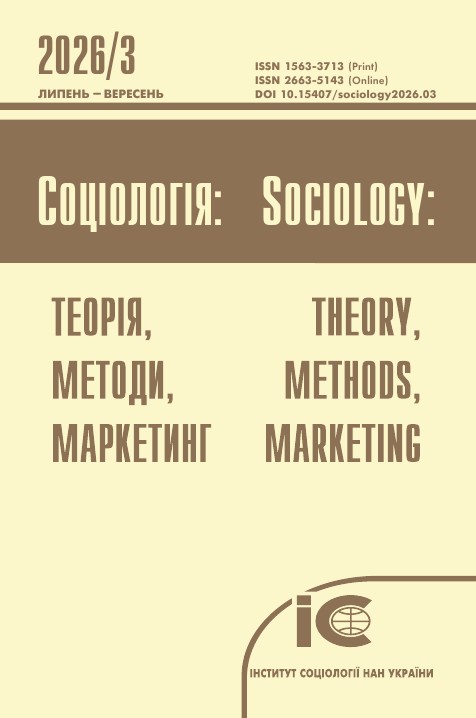
Scientific Journal "Sociology: Theory, Methods, Marketing"
LATEST PRINTED ISSUE
LATEST FREELY ACCESSIBLE MATERIALS
Online learning and performance anxiety among vocal university students in a Ukrainian frontline city during wartime in the context of sociology of music
stmm. 2026 (3): 176–191
DOI https://doi.org/10.15407/sociology2026.03.176
Full text: https://stmm.in.ua/archive/ukr/2026-3/12.pdf
KATERYNA BATAEVA, Doctor of Sciences in Philosophy, Professor at the Department of Social Rehabilitation Technologies, Zhytomyr Institute of Economics and Humanities, University “Ukraine” (18, Vilskyi Shliakh St., Zhytomyr, 10020)
bataevaekaterina72@yahoo.com
https://orcid.org/0000-0002-4628-4817
SCOPUS ID: 57204186366
OLHA BATAIEVA, Leading concertmaster, Department of Solo Singing and Opera Training, Kharkiv I. Kotlyarevsky National University of Arts (11/13, Maidan Konstytutsii, Kharkiv, 61003)
olhabataieva69@meta.ua
https://orcid.org/0009-0000-6180-5265
In this article, we explore the specifics of online learning and music performance anxiety among vocal students at a conservatory in a frontline city of Kharkiv during the Russo-Ukrainian war. The empirical part of the article is based on the results of a study conducted from September to December 2025 using semi-structured interviews with twelve vocal students at the Kharkiv I. Kotlyarevsky National University of Arts. This article compares (1) online vocal learning and face-to-face lessons with professional collaborative pianists and teachers; and (2) online performances at virtual concerts with participation in live concerts held in basements or safer cities in Ukraine. Our research reveals the disadvantages of online learning for vocal students during the war: poor acoustics at home; lack of emotional and physical contact with the teacher and collaborative pianist; the absence, or significant limitation of public performances; irregular vocal lessons; and a decrease in motivation to learn. The advantages of online learning and performances for vocal students include the opportunity to focus on self-education; improvement of skills in working with various internet platforms for editing audio and video; and improvement of skills in critical self-analysis of their performances based on recordings. The current study found out two factors affecting vocal university students’ MPA during the war: prolonged online learning and negative emotions associated with frequent shelling of the frontline city. It can be concluded that prolonged online learning interrupts vocal students’ experience of accumulating public performances in front of a live audience, which does not contribute to the formation of a musician’s self-efficacy (especially if this occurs during the formation of their professional identity).
Keywords: online learning, music performance anxiety (MPA), vocal university students, wartime, sociology of music
References:
-
ACLED's Ukraine Conflict Monitor. (2025). Retrieved from: https://acleddata.com/monitor/ukraine-conflict-monitor
-
Bandura, A. (1997). Self-efficacy: The exercise of control. New York: W.H. Freeman and Co.
-
Bataeva, E. & von Löwis, S. (2025). Higher Education in a Frontline City During the Russian-Ukrainian War and COVID-19 Pandemic. In: O. Lytvynov, V. Pavlikov, D. Krytskyi (Eds.), Lecture Notes in Networks and Systems (1474, pp. 156-167). Cham, ZUG: Springer. https://doi.org/10.1007/978-3-031-94852-7_13
-
Bataeva, K. (2025). Higher education in a frontline city during the Russian-Ukrainian war: cumulative effects of prolonged online learning. [In Ukrainian]. Sociology: Theory, Methods, Marketing, 2, 116-134. https://doi.org/10.15407/sociology2025.02.116
-
Bataeva, E. (2026). Front line and frontline cities during the Russian-Ukrainian war in the context of border and urban studies. Journal of Borderlands Studies, 1-25. https://doi.org/10.1080/08865655.2026.2637495
-
Biasutti, M., Antonini Philippe, R., & Schiavio, A. (2022). Assessing teachers' perspectives on giving music lessons remotely during the COVID-19 lockdown period. Musicae Scientiae, 26(3), 585-603. https://doi.org/10.1177/1029864921996033
-
Biwer, F., Wiradhany, W., Oude Egbrink, M., Hospers, H., Wasenitz, S., Jansen, W. et al. (2021). Changes and adaptations: how University students self-regulate their online learning during the COVID-19 pandemic. Frontiers in Psychology, 12, 1-12. https://doi.org/10.3389/fpsyg.2021.642593
-
Barbeau, A.-K., Boucher, H., & Héroux, I. (2023). The effects of the pandemic on music teaching in schools in Quebec (Canada) in the spring and fall of 2020. International Journal of Music Education, 42(2), 285-299. https://doi.org/10.1177/02557614231157101
-
Barros, S., Marinho, H., França, A. B., & Pereira, A. (2024). Music performance anxiety: A study of anxiety predictors in higher education music students in Portugal. International Journal of Music Education, September. https://doi.org/10.1177/02557614241280040
-
Calderуn-Garrido, D. & Gustems-Carnicer, G. (2021). Adaptations of music education in primary and secondary school due to COVID-19: The experience in Spain. Music Education Research, 23(2), 139-150. https://doi.org/10.1080/14613808.2021.1902488
-
Camlin, D. & Lisboa, T. (2021). The digital 'turn' in music education (editorial). Music Education Research, 23(2), 129-138. https://doi.org/10.1080/14613808.2021.1908792
-
Casanova, O., Zarza, F.J., & Orejudo, S. (2018). Differences in performance anxiety levels among advanced conservatory students in Spain, according to type of instrument and academic year of enrolment. Music Education Research, 20, 377-389. https://doi.org/10.1080/14613808.2018.1433145
-
Cheng, L., Lam, C.Y., & Leung, C.H. (2023). Digital competencies of music teachers under the 'new normal' in Hong Kong. International Journal of Music Education, 42(4), 535-549. https://doi.org/10.1177/02557614231186413
-
Chernyavska, M., Savchenko, H., & Borysenko, M. (2025). Situatedness generated by war: Artistic reaction of Kharkiv musicians to the military aggression and its consequences. Art Design and Communication in Higher Education 24(1): 77-94. https://doi.org/10.1386/adch_00109_1
-
Coşkun-Şentürk, G. & Çırakoğlu, O.C. (2017). How guilt/shame proneness and coping styles are related to music performance anxiety and stress symptoms by gender. Psychology of Music, 46(5), 682-698. https://doi.org/10.1177/0305735617721338
-
Crawford, R. (2017). Rethinking teaching and learning pedagogy for education in the twenty-first century: blended learning in music education. Music Education Research, 19(2), 195-213. https://doi.org/10.1080/14613808.2016.1202223
-
Dammers, R.J. (2009). Utilizing internet-based videoconferencing for instrumental music lessons. Update Applications of Research in Music Education, 28, 17-24. https://doi.org/10.1177/8755123309344159
-
De Bruin, L. (2021). Instrumental music educators in a COVID landscape: a reassertion of relationality and connection in teaching practice. Frontiers in Psychology, 11, 1-12. https://doi.org/10.3389/fpsyg.2020.624717
-
Dembitskyi, S., Golovakha, Ye., Stepanenko, V. (2025). Stressful conditions of the Ukrainian population in the context of war: experience of sociological research. [In Ukrainian]. Kyiv: Institute of Sociology, NAS of Ukraine. https://doi.org/10.15407/book6.978-617-14-0327-7
-
Dembitskyi, S., Stepanenko, V., Zlobina, O., Golovakha, Ye., Naidionova, L. (2024). Psychological stressors of wartime: prevalence and effects among the population of Ukraine. [In Ukrainian]. Sociology: Theory, Methods, Marketing, 4, 5-26. https://doi.org/10.15407/sociology2024.04.005
-
Densley, B., Andrews, K., & Flynn, T. (2025). How Australian singers experienced disruption to choir participation caused by pandemic lockdowns: A thematic analysis. Psychology of Music, 53(1), 111-126. https://doi.org/10.1177/03057356241234052
-
Digolo, B.A., Andang'o, E.A., & Katuli, J. (2011). E-Learning as a Strategy for Enhancing Access to Music Education. International Journal of Business and Social Science, 1(11), 135-139.
-
Dobos, B., Piko, B.F., & Kenny, D.T. (2019). Music performance anxiety and its relationship with social phobia and dimensions of perfectionism. Research Studies in Music Education, 41(3), 310-326. https://doi.org/10.1177/1321103X18804295
-
Filanová, J., Ondrašová, I. & Töröková, A. (2020). Quality evaluation of audio and video signals in videoconferences. Acta Polytechnica Hungarica, 17(7), 89-108. https://doi.org/10.12700/APH.17.7.2020.7.5
-
Franěk, M. (2009). Is noise sensitivity influenced by musical factors. In: 10th WSEAS International Conference on Acoustics & Music: Theory & Applications. Wiscons, United States. Retrieved from: https://www.researchgate.net/publication/228436041_Is_noise_sensitivity_influenced_by_musical_factors
-
Gaunt, H. (2011). Understanding the one-to-one relationship in instrumental/vocal tuition in Higher Education: comparing student and teacher perceptions. British Journal of Music Education, 28, 159-179. https://doi.org/10.1017/S0265051711000052
-
Hash, P.M. (2021). Remote learning in school bands during COVID-19 shutdown. Journal of Research in Music Education, 68(4), 381-397. https://doi.org/10.1177/0022429420967008
-
Hernández, A.M. (2021). Online learning in higher music education: Benefits, challenges and drawbacks of one-to-one videoconference instrumental lessons. Journal of Music, Technology and Education, 13(2-3), 181-197. https://doi.org/10.1386/jmte_00022_1
-
International organization for migration (IOM). (2024). Retrieved from: https://dtm.iom.int/reports/ukraine-thematic-brief-frontline-mobility-and-needs-monitoring-may-2024
-
Iusca, D. & Dafinoiu, I. (2012). Performance anxiety and musical level of undergraduate students in exam situations: The role of gender and musical instrument. Procedia - Social and Behavioral Sciences, 33, 448-452. https://doi.org/10.1016/j.sbspro.2012.01.161
-
Kaleсska-Rodzaj, J. (2023). Emotionality and performance: An emotion-regulation approach to music performance anxiety. Musicae Scientiae, 27(4), 842-861. https://doi.org/10.1177/10298649231173565
-
Kenny, D.T., Davis, P.J., & Oates, J. (2004). Music performance anxiety and occupational stress amongst opera chorus artists and their relationship with state and trait anxiety and perfectionism. Journal of Anxiety Disorders, 18, 757-777. https://doi.org/10.1016/j.janxdis.2003.09.004
-
Kenny, D.T., Driscoll, T., & Ackermann, B. (2012). Psychological well-being in professional orchestral musicians in Australia: A descriptive population study. Psychology of Music, 42, 210-232. https://doi.org/10.1177/0305735612463950
-
Kirchner, J.M., Bloom, A.J., & Skutnick-Henley, P. (2008). The relationship between performance anxiety and flow. Medical Problems of Performing Artists, 23(2), 59-65. https://doi.org/10.21091/mppa.2008.2012
-
Kurapov, A., Pavlenko, V., Drozdov, A., Korchakova, N., & Pavlova, I. (2024). Impact of War on Ukrainian University Students and Personnel: Repeated Cross-Sectional Study. Journal of Loss and Trauma, 29, 1-17. https://doi.org/10.1080/15325024.2023.2280603
-
Kurkul, W. (2007). Nonverbal communication in one-to-one music performance instruction. Psychology of Music, 35(2), 327-362. https://doi.org/10.1177/0305735607070385
-
Lisboa, T., Jуnasson, P., & Johnson, C. (2020). Synchronous online learning, teaching and performing. In: G. McPherson (Ed.), The Oxford Handbook of Music Performance (vol. 2, pp. 499-527). Oxford: Oxford University Press. https://doi.org/10.1093/oxfordhb/9780190058869.013.23
-
López-Íñiguez, G. & McPherson, G.E. (2021). Regulation of emotions to optimize classical music performance: A quasi-experimental study of a cellist-researcher. Frontiers in Psychology, 12, 1-12. https://doi.org/10.3389/fpsyg.2021.627601
-
McClellan, E., Vestby, S., Lang, J., & Ehrlich, A. (2023). Sociological Aspects of Music Education in Higher Education in Brazil, Canada, Israel, Norway, and the United States During the COVID-19 Pandemic. Visions of Research in Music Education, 42, 1-20.
-
McCormick, J. & McPherson, G.E. (2003). The role of self-efficacy in a musical performance examination: an exploratory structural equation analysis. Psychology of Music, 31, 37-51. https://doi.org/10.1177/0305735603031001322
-
Naydonova, L., Dembitskyi, S., & Stepanenko, V. (2024). Predictors and protectors of the risk of developing post-traumatic stress disorder in Ukrainians as a result of the Russian-Ukrainian war: Demographic aspects and war stressors. Scientific Studios on Social and Political Psychology, 31(2), 6-16. https://doi.org/10.61727/sssppj/2.2024.06
-
Nugroho, D. & Biasutti, M. (2024). Instructors' perspectives on teaching music online after the COVID-19 lockdown: A qualitative analysis in Indonesia. Journal of University Teaching and Learning Practice, 21(3), 1-26. https://doi.org/10.53761/3dqqzp79
-
Nusseck, M. & Spahn, C. (2021). Musical practice in music students during COVID-19 lockdown. Frontiers in Psychology, 12, 1-8. https://doi.org/10.3389/fpsyg.2021.643177
-
Orejudo, S., Zarza, F.J., Casanova, O., Rodríguez, C., & Mazas, B. (2017). The relation of music performance anxiety (MPA) to optimism, self-efficacy, and sensitivity to reward and punishment: Testing Barlow's theory of personal vulnerability on a sample of Spanish music students. Psychology of Music, 45(4), 570-583. https://doi.org/10.1177/0305735616674791
-
Paliaukiene, V., Kazlauskas, E., Eimontas, J., & Skeryte-Kazlauskiene, M. (2018). Music performance anxiety among students of the academy in Lithuania. Music Education Research, 20, 390-397. https://doi.org/10.1080/14613808.2018.1445208
-
Pekrun, R., Goetz, T., Frenzel, A.C., Barchfeld, P., & Perry, R.P. (2011). Measuring emotions in students' learning and performance: The Achievement Emotions Questionnaire (AEQ). Contemporary Educational Psychology, 36(1), 36-48. https://doi.org/10.1016/j.cedpsych.2010.10.002
-
Perdomo-Guevara, E. & Dibben, N. (2025). Cultivating meaning and self-transcendence to increase positive emotions and decrease anxiety in music performance. Psychology of Music, 53(3), 337-354. https://doi.org/10.1177/03057356241246052
-
Riley, H., MacLeod, R., & Libera, M. (2016). Low latency audio video. Applications of Research in Music Education, 34(3), 15-23. https://doi.org/10.1177/8755123314554403
-
Rucsanda, M.D., Belibou, A., & Cazan, A. (2021). Students' Attitudes Toward Online Music Education During the COVID 19 Lockdown. Frontiers in Psychology, 12, 1-10. https://doi.org/10.3389/fpsyg.2021.753785
-
Schmidt-Jones, C.A. (2017). The promise and challenge of online action research: notes from a study of self-motivated online music learners. Action Research, 18, 372-386. https://doi.org/10.1177/1476750317698026
-
Setiarini, A. (2021). Distance learning for music practice in college: Benefits, drawbacks, and challenges. Grenek Music Journal, 10(2), 43-53. https://doi.org/10.24114/grenek.v10i2.27900
-
Simones, L.L., Rodger, M., & Schroeder, F. (2015). Communicating musical knowledge through gesture: Piano teachers' gestural behaviours across different levels of student proficiency. Psychology of Music, 43(5), 723-735. https://doi.org/10.1177/0305735614535830
-
Smith, G., Moir, Z., Ferguson, P., & Davies, G. (2020). Low-latency networked music collaborations: Does "good enough" do enough good? Journal of Network Music and Arts, 2, 1-23.
-
Stepanenko, V., Zlobina, O., Golovakha, Ye., Dembitskyi, S., Naidionova, L. (2023). Stress caused by war and resources of socio-psychological resilience: a review of theoretical conceptualizations. [In Ukrainian]. Sociology: Theory, Methods, Marketing, 4, 22-39 https://doi.org/10.15407/sociology2023.04.022
-
Stieger, S., Lewetz, D., Paschenko, S., & Kurapov, A. (2023). Examining terror management theory in Ukraine: impact of air-raid alarms and explosions on mental health, somatic symptoms, and well-being. Frontiers in Psychiatry, 14, 1-16. https://doi.org/10.3389/fpsyt.2023.1244335
-
The Swedish Research Council. (2017). Retrieved from: https://www.vr.se/english/analysis/reports/our-reports/2017-08-31-good-research-practice.html
-
Tsugawa, S. (2023). Bridging the Digital Divide: Distance music learning among older adult musicians. International Journal of Music Education, 41(1), 52-68. https://doi.org/10.1177/02557614221091888
-
Varadi, J., Miklos Radocz, J., Mike, A., Ovary, Z., & Jozsa, G. (2024). Lessons from the COVID pandemic in music education the advantages and disadvantages of online music education. Heliyon, 10(18), 1-9. https://doi.org/10.1016/j.heliyon.2024.e35357
-
Yıldız, Y., Karşal, E., & Bağcı, H. (2021). Examining the instructors' perspectives on undergraduate distance learning music instrument education during the COVID-19 pandemic. Journal of Pedagogical Research, 5(2), 184-206. https://doi.org/10.33902/JPR.2021270107
-
Yondem, Z.D. (2007). Performance anxiety, dysfunctional attitudes and gender in university music students. Social Behavior and Personality, 35(10), 1415-1426. https://doi.org/10.2224/sbp.2007.35.10.1415
-
Zarza, F.J., Orejudo, S., Casanova, O., & Aparicio-Moreno, L. (2018). Music performance anxiety in adolescence and early adulthood: Its relation with the age of onset in musical training. Psychology of Music, 46(1), 1-15. https://doi.org/10.1177/0305735617691592
-
Zarza-Alzugaray, F.J., Casanova, O., McPherson, G.E., & Orejudo, S. (2020). Music Self-Efficacy for Performance: An Explanatory Model Based on Social Support. Frontiers in Psychology, 11, 1-14. https://doi.org/10.3389/fpsyg.2020.01249
- Zelenak, M.S. (2020). Developing Self-Efficacy to Improve Music Achievement. Music Educators Journal, 107(2): 42-50. https://doi.org/10.1177/0027432120950812
Received 07.02.2026
Accepted for publication after review 12.06.2026
Online learning and performance anxiety among vocal university students in a Ukrainian frontline city during wartime in the context of sociology of music
stmm. 2026 (3): 176–191
DOI https://doi.org/10.15407/sociology2026.03.176
Full text: https://stmm.in.ua/archive/ukr/2026-3/12.pdf
KATERYNA BATAEVA, Doctor of Sciences in Philosophy, Professor at the Department of Social Rehabilitation Technologies, Zhytomyr Institute of Economics and Humanities, University “Ukraine” (18, Vilskyi Shliakh St., Zhytomyr, 10020)
bataevaekaterina72@yahoo.com
https://orcid.org/0000-0002-4628-4817
SCOPUS ID: 57204186366
OLHA BATAIEVA, Leading concertmaster, Department of Solo Singing and Opera Training, Kharkiv I. Kotlyarevsky National University of Arts (11/13, Maidan Konstytutsii, Kharkiv, 61003)
olhabataieva69@meta.ua
https://orcid.org/0009-0000-6180-5265
In this article, we explore the specifics of online learning and music performance anxiety among vocal students at a conservatory in a frontline city of Kharkiv during the Russo-Ukrainian war. The empirical part of the article is based on the results of a study conducted from September to December 2025 using semi-structured interviews with twelve vocal students at the Kharkiv I. Kotlyarevsky National University of Arts. This article compares (1) online vocal learning and face-to-face lessons with professional collaborative pianists and teachers; and (2) online performances at virtual concerts with participation in live concerts held in basements or safer cities in Ukraine. Our research reveals the disadvantages of online learning for vocal students during the war: poor acoustics at home; lack of emotional and physical contact with the teacher and collaborative pianist; the absence, or significant limitation of public performances; irregular vocal lessons; and a decrease in motivation to learn. The advantages of online learning and performances for vocal students include the opportunity to focus on self-education; improvement of skills in working with various internet platforms for editing audio and video; and improvement of skills in critical self-analysis of their performances based on recordings. The current study found out two factors affecting vocal university students’ MPA during the war: prolonged online learning and negative emotions associated with frequent shelling of the frontline city. It can be concluded that prolonged online learning interrupts vocal students’ experience of accumulating public performances in front of a live audience, which does not contribute to the formation of a musician’s self-efficacy (especially if this occurs during the formation of their professional identity).
Keywords: online learning, music performance anxiety (MPA), vocal university students, wartime, sociology of music
References:
-
ACLED's Ukraine Conflict Monitor. (2025). Retrieved from: https://acleddata.com/monitor/ukraine-conflict-monitor
-
Bandura, A. (1997). Self-efficacy: The exercise of control. New York: W.H. Freeman and Co.
-
Bataeva, E. & von Löwis, S. (2025). Higher Education in a Frontline City During the Russian-Ukrainian War and COVID-19 Pandemic. In: O. Lytvynov, V. Pavlikov, D. Krytskyi (Eds.), Lecture Notes in Networks and Systems (1474, pp. 156-167). Cham, ZUG: Springer. https://doi.org/10.1007/978-3-031-94852-7_13
-
Bataeva, K. (2025). Higher education in a frontline city during the Russian-Ukrainian war: cumulative effects of prolonged online learning. [In Ukrainian]. Sociology: Theory, Methods, Marketing, 2, 116-134. https://doi.org/10.15407/sociology2025.02.116
-
Bataeva, E. (2026). Front line and frontline cities during the Russian-Ukrainian war in the context of border and urban studies. Journal of Borderlands Studies, 1-25. https://doi.org/10.1080/08865655.2026.2637495
-
Biasutti, M., Antonini Philippe, R., & Schiavio, A. (2022). Assessing teachers' perspectives on giving music lessons remotely during the COVID-19 lockdown period. Musicae Scientiae, 26(3), 585-603. https://doi.org/10.1177/1029864921996033
-
Biwer, F., Wiradhany, W., Oude Egbrink, M., Hospers, H., Wasenitz, S., Jansen, W. et al. (2021). Changes and adaptations: how University students self-regulate their online learning during the COVID-19 pandemic. Frontiers in Psychology, 12, 1-12. https://doi.org/10.3389/fpsyg.2021.642593
-
Barbeau, A.-K., Boucher, H., & Héroux, I. (2023). The effects of the pandemic on music teaching in schools in Quebec (Canada) in the spring and fall of 2020. International Journal of Music Education, 42(2), 285-299. https://doi.org/10.1177/02557614231157101
-
Barros, S., Marinho, H., França, A. B., & Pereira, A. (2024). Music performance anxiety: A study of anxiety predictors in higher education music students in Portugal. International Journal of Music Education, September. https://doi.org/10.1177/02557614241280040
-
Calderуn-Garrido, D. & Gustems-Carnicer, G. (2021). Adaptations of music education in primary and secondary school due to COVID-19: The experience in Spain. Music Education Research, 23(2), 139-150. https://doi.org/10.1080/14613808.2021.1902488
-
Camlin, D. & Lisboa, T. (2021). The digital 'turn' in music education (editorial). Music Education Research, 23(2), 129-138. https://doi.org/10.1080/14613808.2021.1908792
-
Casanova, O., Zarza, F.J., & Orejudo, S. (2018). Differences in performance anxiety levels among advanced conservatory students in Spain, according to type of instrument and academic year of enrolment. Music Education Research, 20, 377-389. https://doi.org/10.1080/14613808.2018.1433145
-
Cheng, L., Lam, C.Y., & Leung, C.H. (2023). Digital competencies of music teachers under the 'new normal' in Hong Kong. International Journal of Music Education, 42(4), 535-549. https://doi.org/10.1177/02557614231186413
-
Chernyavska, M., Savchenko, H., & Borysenko, M. (2025). Situatedness generated by war: Artistic reaction of Kharkiv musicians to the military aggression and its consequences. Art Design and Communication in Higher Education 24(1): 77-94. https://doi.org/10.1386/adch_00109_1
-
Coşkun-Şentürk, G. & Çırakoğlu, O.C. (2017). How guilt/shame proneness and coping styles are related to music performance anxiety and stress symptoms by gender. Psychology of Music, 46(5), 682-698. https://doi.org/10.1177/0305735617721338
-
Crawford, R. (2017). Rethinking teaching and learning pedagogy for education in the twenty-first century: blended learning in music education. Music Education Research, 19(2), 195-213. https://doi.org/10.1080/14613808.2016.1202223
-
Dammers, R.J. (2009). Utilizing internet-based videoconferencing for instrumental music lessons. Update Applications of Research in Music Education, 28, 17-24. https://doi.org/10.1177/8755123309344159
-
De Bruin, L. (2021). Instrumental music educators in a COVID landscape: a reassertion of relationality and connection in teaching practice. Frontiers in Psychology, 11, 1-12. https://doi.org/10.3389/fpsyg.2020.624717
-
Dembitskyi, S., Golovakha, Ye., Stepanenko, V. (2025). Stressful conditions of the Ukrainian population in the context of war: experience of sociological research. [In Ukrainian]. Kyiv: Institute of Sociology, NAS of Ukraine. https://doi.org/10.15407/book6.978-617-14-0327-7
-
Dembitskyi, S., Stepanenko, V., Zlobina, O., Golovakha, Ye., Naidionova, L. (2024). Psychological stressors of wartime: prevalence and effects among the population of Ukraine. [In Ukrainian]. Sociology: Theory, Methods, Marketing, 4, 5-26. https://doi.org/10.15407/sociology2024.04.005
-
Densley, B., Andrews, K., & Flynn, T. (2025). How Australian singers experienced disruption to choir participation caused by pandemic lockdowns: A thematic analysis. Psychology of Music, 53(1), 111-126. https://doi.org/10.1177/03057356241234052
-
Digolo, B.A., Andang'o, E.A., & Katuli, J. (2011). E-Learning as a Strategy for Enhancing Access to Music Education. International Journal of Business and Social Science, 1(11), 135-139.
-
Dobos, B., Piko, B.F., & Kenny, D.T. (2019). Music performance anxiety and its relationship with social phobia and dimensions of perfectionism. Research Studies in Music Education, 41(3), 310-326. https://doi.org/10.1177/1321103X18804295
-
Filanová, J., Ondrašová, I. & Töröková, A. (2020). Quality evaluation of audio and video signals in videoconferences. Acta Polytechnica Hungarica, 17(7), 89-108. https://doi.org/10.12700/APH.17.7.2020.7.5
-
Franěk, M. (2009). Is noise sensitivity influenced by musical factors. In: 10th WSEAS International Conference on Acoustics & Music: Theory & Applications. Wiscons, United States. Retrieved from: https://www.researchgate.net/publication/228436041_Is_noise_sensitivity_influenced_by_musical_factors
-
Gaunt, H. (2011). Understanding the one-to-one relationship in instrumental/vocal tuition in Higher Education: comparing student and teacher perceptions. British Journal of Music Education, 28, 159-179. https://doi.org/10.1017/S0265051711000052
-
Hash, P.M. (2021). Remote learning in school bands during COVID-19 shutdown. Journal of Research in Music Education, 68(4), 381-397. https://doi.org/10.1177/0022429420967008
-
Hernández, A.M. (2021). Online learning in higher music education: Benefits, challenges and drawbacks of one-to-one videoconference instrumental lessons. Journal of Music, Technology and Education, 13(2-3), 181-197. https://doi.org/10.1386/jmte_00022_1
-
International organization for migration (IOM). (2024). Retrieved from: https://dtm.iom.int/reports/ukraine-thematic-brief-frontline-mobility-and-needs-monitoring-may-2024
-
Iusca, D. & Dafinoiu, I. (2012). Performance anxiety and musical level of undergraduate students in exam situations: The role of gender and musical instrument. Procedia - Social and Behavioral Sciences, 33, 448-452. https://doi.org/10.1016/j.sbspro.2012.01.161
-
Kaleсska-Rodzaj, J. (2023). Emotionality and performance: An emotion-regulation approach to music performance anxiety. Musicae Scientiae, 27(4), 842-861. https://doi.org/10.1177/10298649231173565
-
Kenny, D.T., Davis, P.J., & Oates, J. (2004). Music performance anxiety and occupational stress amongst opera chorus artists and their relationship with state and trait anxiety and perfectionism. Journal of Anxiety Disorders, 18, 757-777. https://doi.org/10.1016/j.janxdis.2003.09.004
-
Kenny, D.T., Driscoll, T., & Ackermann, B. (2012). Psychological well-being in professional orchestral musicians in Australia: A descriptive population study. Psychology of Music, 42, 210-232. https://doi.org/10.1177/0305735612463950
-
Kirchner, J.M., Bloom, A.J., & Skutnick-Henley, P. (2008). The relationship between performance anxiety and flow. Medical Problems of Performing Artists, 23(2), 59-65. https://doi.org/10.21091/mppa.2008.2012
-
Kurapov, A., Pavlenko, V., Drozdov, A., Korchakova, N., & Pavlova, I. (2024). Impact of War on Ukrainian University Students and Personnel: Repeated Cross-Sectional Study. Journal of Loss and Trauma, 29, 1-17. https://doi.org/10.1080/15325024.2023.2280603
-
Kurkul, W. (2007). Nonverbal communication in one-to-one music performance instruction. Psychology of Music, 35(2), 327-362. https://doi.org/10.1177/0305735607070385
-
Lisboa, T., Jуnasson, P., & Johnson, C. (2020). Synchronous online learning, teaching and performing. In: G. McPherson (Ed.), The Oxford Handbook of Music Performance (vol. 2, pp. 499-527). Oxford: Oxford University Press. https://doi.org/10.1093/oxfordhb/9780190058869.013.23
-
López-Íñiguez, G. & McPherson, G.E. (2021). Regulation of emotions to optimize classical music performance: A quasi-experimental study of a cellist-researcher. Frontiers in Psychology, 12, 1-12. https://doi.org/10.3389/fpsyg.2021.627601
-
McClellan, E., Vestby, S., Lang, J., & Ehrlich, A. (2023). Sociological Aspects of Music Education in Higher Education in Brazil, Canada, Israel, Norway, and the United States During the COVID-19 Pandemic. Visions of Research in Music Education, 42, 1-20.
-
McCormick, J. & McPherson, G.E. (2003). The role of self-efficacy in a musical performance examination: an exploratory structural equation analysis. Psychology of Music, 31, 37-51. https://doi.org/10.1177/0305735603031001322
-
Naydonova, L., Dembitskyi, S., & Stepanenko, V. (2024). Predictors and protectors of the risk of developing post-traumatic stress disorder in Ukrainians as a result of the Russian-Ukrainian war: Demographic aspects and war stressors. Scientific Studios on Social and Political Psychology, 31(2), 6-16. https://doi.org/10.61727/sssppj/2.2024.06
-
Nugroho, D. & Biasutti, M. (2024). Instructors' perspectives on teaching music online after the COVID-19 lockdown: A qualitative analysis in Indonesia. Journal of University Teaching and Learning Practice, 21(3), 1-26. https://doi.org/10.53761/3dqqzp79
-
Nusseck, M. & Spahn, C. (2021). Musical practice in music students during COVID-19 lockdown. Frontiers in Psychology, 12, 1-8. https://doi.org/10.3389/fpsyg.2021.643177
-
Orejudo, S., Zarza, F.J., Casanova, O., Rodríguez, C., & Mazas, B. (2017). The relation of music performance anxiety (MPA) to optimism, self-efficacy, and sensitivity to reward and punishment: Testing Barlow's theory of personal vulnerability on a sample of Spanish music students. Psychology of Music, 45(4), 570-583. https://doi.org/10.1177/0305735616674791
-
Paliaukiene, V., Kazlauskas, E., Eimontas, J., & Skeryte-Kazlauskiene, M. (2018). Music performance anxiety among students of the academy in Lithuania. Music Education Research, 20, 390-397. https://doi.org/10.1080/14613808.2018.1445208
-
Pekrun, R., Goetz, T., Frenzel, A.C., Barchfeld, P., & Perry, R.P. (2011). Measuring emotions in students' learning and performance: The Achievement Emotions Questionnaire (AEQ). Contemporary Educational Psychology, 36(1), 36-48. https://doi.org/10.1016/j.cedpsych.2010.10.002
-
Perdomo-Guevara, E. & Dibben, N. (2025). Cultivating meaning and self-transcendence to increase positive emotions and decrease anxiety in music performance. Psychology of Music, 53(3), 337-354. https://doi.org/10.1177/03057356241246052
-
Riley, H., MacLeod, R., & Libera, M. (2016). Low latency audio video. Applications of Research in Music Education, 34(3), 15-23. https://doi.org/10.1177/8755123314554403
-
Rucsanda, M.D., Belibou, A., & Cazan, A. (2021). Students' Attitudes Toward Online Music Education During the COVID 19 Lockdown. Frontiers in Psychology, 12, 1-10. https://doi.org/10.3389/fpsyg.2021.753785
-
Schmidt-Jones, C.A. (2017). The promise and challenge of online action research: notes from a study of self-motivated online music learners. Action Research, 18, 372-386. https://doi.org/10.1177/1476750317698026
-
Setiarini, A. (2021). Distance learning for music practice in college: Benefits, drawbacks, and challenges. Grenek Music Journal, 10(2), 43-53. https://doi.org/10.24114/grenek.v10i2.27900
-
Simones, L.L., Rodger, M., & Schroeder, F. (2015). Communicating musical knowledge through gesture: Piano teachers' gestural behaviours across different levels of student proficiency. Psychology of Music, 43(5), 723-735. https://doi.org/10.1177/0305735614535830
-
Smith, G., Moir, Z., Ferguson, P., & Davies, G. (2020). Low-latency networked music collaborations: Does "good enough" do enough good? Journal of Network Music and Arts, 2, 1-23.
-
Stepanenko, V., Zlobina, O., Golovakha, Ye., Dembitskyi, S., Naidionova, L. (2023). Stress caused by war and resources of socio-psychological resilience: a review of theoretical conceptualizations. [In Ukrainian]. Sociology: Theory, Methods, Marketing, 4, 22-39 https://doi.org/10.15407/sociology2023.04.022
-
Stieger, S., Lewetz, D., Paschenko, S., & Kurapov, A. (2023). Examining terror management theory in Ukraine: impact of air-raid alarms and explosions on mental health, somatic symptoms, and well-being. Frontiers in Psychiatry, 14, 1-16. https://doi.org/10.3389/fpsyt.2023.1244335
-
The Swedish Research Council. (2017). Retrieved from: https://www.vr.se/english/analysis/reports/our-reports/2017-08-31-good-research-practice.html
-
Tsugawa, S. (2023). Bridging the Digital Divide: Distance music learning among older adult musicians. International Journal of Music Education, 41(1), 52-68. https://doi.org/10.1177/02557614221091888
-
Varadi, J., Miklos Radocz, J., Mike, A., Ovary, Z., & Jozsa, G. (2024). Lessons from the COVID pandemic in music education the advantages and disadvantages of online music education. Heliyon, 10(18), 1-9. https://doi.org/10.1016/j.heliyon.2024.e35357
-
Yıldız, Y., Karşal, E., & Bağcı, H. (2021). Examining the instructors' perspectives on undergraduate distance learning music instrument education during the COVID-19 pandemic. Journal of Pedagogical Research, 5(2), 184-206. https://doi.org/10.33902/JPR.2021270107
-
Yondem, Z.D. (2007). Performance anxiety, dysfunctional attitudes and gender in university music students. Social Behavior and Personality, 35(10), 1415-1426. https://doi.org/10.2224/sbp.2007.35.10.1415
-
Zarza, F.J., Orejudo, S., Casanova, O., & Aparicio-Moreno, L. (2018). Music performance anxiety in adolescence and early adulthood: Its relation with the age of onset in musical training. Psychology of Music, 46(1), 1-15. https://doi.org/10.1177/0305735617691592
-
Zarza-Alzugaray, F.J., Casanova, O., McPherson, G.E., & Orejudo, S. (2020). Music Self-Efficacy for Performance: An Explanatory Model Based on Social Support. Frontiers in Psychology, 11, 1-14. https://doi.org/10.3389/fpsyg.2020.01249
- Zelenak, M.S. (2020). Developing Self-Efficacy to Improve Music Achievement. Music Educators Journal, 107(2): 42-50. https://doi.org/10.1177/0027432120950812
Received 07.02.2026
Accepted for publication after review 12.06.2026
LATEST PRINTED ISSUE
LATEST FREELY ACCESSIBLE MATERIALS