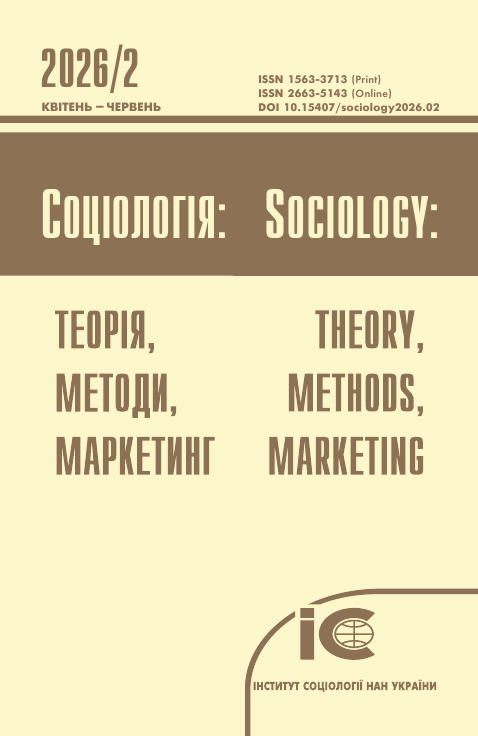
Scientific Journal "Sociology: Theory, Methods, Marketing"
LATEST PRINTED ISSUE
LATEST FREELY ACCESSIBLE MATERIALS
The roles of sociology in wartime Ukraine and its contribu-tions to global sociology
stmm. 2026 (2): 29-48
DOI https://doi.org/10.15407/sociology2026.02.029
Full text: https://stmm.in.ua/archive/ukr/2026-2/5.pdf
GEOFFREY PLEYERS, President of the International Sociological Association, Professor at the Catholic University of Louvain — Université catholique de Louvain (UCL, Belgium); Director of the National Fund for Scientific Research — Fonds national pour la recherche scientifique (FNRS, Belgium)
Geoffrey.Pleyers@uclouvain.be
https://orcid.org/0000-0001-9949-5047
This article is dedicated to the study of the phenomenon of Ukrainian national resilience under the conditions of full-scale Russian aggression. The author analyzes the civilizational determinants of Ukrainian society's resistance, which extend beyond traditional military-political and economic factors. Russia's war against Ukraine is interpreted as a manifestation of the global confrontation between democratic and authoritarian models of social order, wherein Ukraine acts as a frontier state, defending the fundamental principles of the free world. It is argued that Ukrainian resilience holds not only local but also global civilizational significance.
Keywords: national resilience, civilizational choice, Russo-Ukrainian war, Ukrainian identity, values, democracy, authoritarianism, social cohesion
References:
-
Golovakha, Ye. & Dembitskyi, S. (Eds.). (2024). Ukrainian Society in Wartime. The Year 2024. Kyiv: Institute of Sociology, National Academy of Sciences of Ukraine. https://doi.org/10.15407/book8.978-617-14-0292-8
-
Arugay, A. & Baquisal, J. (2023). Bowed, bent, & broken: Duterte's assaults on civil society in the Philippines. Journal of Current Southeast Asian Affairs, 42(3), 328-349. https://doi.org/10.1177/18681034231209504
-
Bakirov, V. & Golovakha, Ye. (Eds.). (2018). Ukrainian Sociology in the 21st Century: Theory, Methods, Research Results. Kharkiv: V.N. Karazin Kharkiv National University.
-
Bakirov, V. (2025). The Phenomenon of Ukrainian Resilience: The Synergy of Sociocultural Factors. Keynote at the Fifth Ukrainian Congress of Sociology, 20-21 November. Retrieved from: https://sau.in.ua/
-
Bakke, K., Dahl, M., & Rickard, K. (2025). Conflict exposure and democratic values: Evidence from wartime Ukraine. Journal of Peace Research, 62(5), 1376-1392. https://doi.org/10.1177/00223433251347769
-
Bloch, E. (1986 [1954]). The Principle of Hope. Vol. 1. Cambridge, MA: MIT Press.
-
Boichak, O. & McKernan, B. (2024). Narratives of volunteering and social change in wartime Ukraine. Cultural Sociology, 18(1), 48-71. https://doi.org/10.1177/17499755221127877
-
Bradshaw, S., Elswah, M., Haque, M., & Quelle, D. (2024). Strategic storytelling: Russian state-backed media coverage of the Ukraine war. International Journal of Public Opinion Research, 36(3), edae028. https://doi.org/10.1093/ijpor/edae028
-
Burawoy, M. (2021). Public Sociology. Cambridge: Polity.
-
Coles, J., Astbury, J., Dartnall, E., & Limjerwala, S. (2014). A qualitative exploration of researcher trauma and researchers' responses to investigating sexual violence. Violence Against Women, 20(1), 95-117. https://doi.org/10.1177/1077801213520578
-
Costas, J., Prokhorova, A., Stepanenko, V., Sudyn, D., Yermolenko, V., & Zaremba-Kosovych, H. (2024). Academic activism in time of war: Voices from Ukraine. Organization, 32(5), 760-771. https://doi.org/10.1177/13505084241284487
-
Emeran, C. (2017). New Generation Political Activism in Ukraine 2000-2014. Routledge. https://doi.org/10.4324/9781315597966
-
Fassin, D. (2025). Moral Abdication: How the World Failed to Stop the Destruction of Gaza. London: Verso.
-
Golovakha, Y., Ivashchenko-Stadnik, K., Mikheieva, O., & Sereda, V. (2023). From patronalism to civic belonging: The changing dynamics of the national-civic identity in Ukraine. In: B. Madlovics & B. Magyar (Eds.), Ukraine's Patronal Democracy and the Russian Invasion (pp. 297-329). Vienna: Central European University Press. https://doi.org/10.1515/9789633866641-012
-
Grushetsky, A. & Paniotto, V. (2025). War and the Transformation of Ukrainian society (2022-23). Empirical Evidence. Stuttgart: Ibidem Press.
-
Grzebyk P. & Uczkiewicz, D. (Eds.). (2025). The Russian-Ukrainian Conflict and War Crimes: Challenges for Documentation and International Prosecution. Routledge. https://doi.org/10.4324/9781003493785
-
Holovakha, Ye. (2025). Socio-political transformations in contemporary Ukrainian society. Guest lecture at the Ivan Franko National University of Lviv, 30 October. Retrieved from: https://lnu.edu.ua/lvivskyy-universytet-vidvidav-profesor-yevhen-holovakha/
-
Hrybenko, O. (2025). Intermediaries of change: How media-focused non-governmental organizations shape meta-journalistic discourse in Ukraine. Journalism, 26(4), 862-880. https://doi.org/10.1177/14648849241281179
-
ISAR Ednannia. (2023). A study of recovery initiatives in Ukraine: Mapping post-war recovery initiatives (2022-March 2023). KIIS - Kyiv International Institute of Sociology. Retrieved from: https://ednannia.ua/images/A_study_of_recovery_initiatives_in_Ukraine.pdf
-
Jawad, R., Dawani, S., Shehadeh, S., & Nateel, B. (2025). Against Frames of Trauma and Testimony: Palestinian children's narratives from within a contemporary genocide. Journal of Palestine Studies, 54(3), 71-82. https://doi.org/10.1080/0377919X.2025.2560304
-
Karakai, D. & Moskotina, R. (2025). Existential upheavals: Tracing war's immediate effect on individual religiosity in Ukraine. Social Compass, 72(1), 66-85. https://doi.org/10.1177/00377686241311421
-
KIIS - Kyiv International Institute of Sociology. (2024). To what extent do Ukrainians consider Ukraine a democratic country and the priority of a democratic system? Retrieved from: https://kiis.com.ua/?lang=eng&cat=reports&id=1406&page=1
-
Klein, E. et al. (2025). Public opinion research in Ukraine under wartime conditions. Ukrainian Analytical Digest, 6, 2-4. [ETH Zurich Research Collection]. https://doi.org/10.31205/UA.318.01
-
Klosterkamp, S., Jeffrey, A. (2024). The intimate geopolitics of evidence gathering in war crime investigation in Ukraine. Political Geography Open Research, 3, 100008. https://doi.org/10.1016/j.jpgor.2024.100008
-
Kostenko, A. et al. (2024). Resilience and vulnerability of Ukrainians: The role of family during the war. Problems and Perspectives in Management, 22(1), 432-445. https://doi.org/10.21511/ppm.22(1).2024.35
-
Krymets, L., Saienko, O., Nedvyha, O., Tserkovnyak-Horodets'ka, O., & Logvinenko, N. (2025). The formation of Ukrainian national identity in the context of Russian aggression: A philosophical and psychological analysis. International Journal on Culture, History, and Religion, 7(SI1), 518-536. https://doi.org/10.63931/ijchr.v7iSI1.153
-
Kutsenko, O. & Babenko, S. (2024). The power of Ukrainian sociology in post-USSR transformations and Russia's war in Ukraine. Іn: B. Roncevic & T.B. Valič (Eds.), Sociology and Post-Socialist Transformations in Eastern Europe (pp. 437-462). London: Springer. https://doi.org/10.1007/978-3-031-65556-2_22
-
Kutsenko, O. (2025a). Democratic resilience: Ukrainian alternative to militant authoritarianism. Іn: B. Wejnert (Ed.), The Global Rise of Autocracy: Its Threat to a Sustainable Future (pp. 251-285). London: Routledge. https://doi.org/10.4324/9781003516583-15
-
Kutsenko, O. (2025b). La sociologie ukrainienne face à la guerre: défis, adaptations et pratiques de recherche. Socio-logos, 21. Retrieved from: http://journals.openedition.org/socio-logos/7013 https://doi.org/10.4000/14k40
-
Kutsenko, O. (2025c). Resilience under fire: Navigating societal challenges, agency, and innovation in times of war. Innovation: The European Journal of Social Science Research, 38(1), 1-10. https://doi.org/10.1080/13511610.2025.2465177
-
Lavrysh, Y., Lytovchenko, I., Lukianenko, V., & Golub, T. (2025). Teaching during wartime: Experience from Ukraine. Educational Philosophy and Theory, 57(3), 197-204. https://doi.org/10.1080/00131857.2022.2098714
-
Levitas, R. (2013). Utopia as Method: The Imaginary Reconstitution of Society. Palgrave. https://doi.org/10.1057/9781137314253
-
Mishalova, O., Hordiichuk, O., & Sokolovskyi, O. (2024). Russia's war in Ukraine as a "war for identity" and appropriation of cultural tradition. Ethics in Progress, 15(1), 73-94. https://doi.org/10.14746/eip.2024.1.4
-
Musleh, A. (2026). Weaving life through stories: Lamlamah - the art of gathering and uplifting "ourselves". Critical and Radical Social Work, 20, 1-16.
-
Nechitailo, I. & Alieva, A. (2025). Resilience of the educational system in conditions of global social upheavals: The ratio of centralization and autonomy. Innovation: The European Journal of Social Science Research, 38(1), 28-49. https://doi.org/10.1080/13511610.2025.2462959
-
Nekoliak, R. (2025). The Centre for Civil Liberties. In: P. Grzebyk & D. Uczkiewicz (Eds.), The Russian-Ukrainian Conflict and War Crimes: Challenges for Documentation and International Prosecution (pp. 159-175). Routledge. https://doi.org/10.4324/9781003493785-12
-
OHCHR/UN. (2026). Ukraine: Protection of civilians in armed conflict. December 2025 update. Office of the United Nations High Commissioner for Human Rights. Retrieved from: https://ukraine.ohchr.org/sites/default/files/2026-01/Ukraine%20-%20protection%20of%20civilians%20in%20armed%20conflict%20%28December%202025%29_ENG.pdf
-
Oinas, E., Onodera, H., & Suurpää, L. (Eds.). (2018). What politics? Youth and political engagement in Africa. Brill. https://doi.org/10.1163/9789004356368
-
Oleinik, A. (2018). Building Ukraine from within: A sociological, institutional, and economic analysis of a nation-state in the making. Stuttgart: Ibidem Press.
-
Oleinik, A. & Paniotto, V. (2024). Propaganda channels and their comparative effectiveness: The case of Russia's war in Ukraine. International Sociology, 39(3), 217-240. https://doi.org/10.1177/02685809241232637
-
Paniotto, V. (2024). Methods for data quality assessment in wartime surveys in Ukraine. Public opinion research in Ukraine under wartime conditions. Ukrainian Analytical Digest, 6, 9-13. [ETH Zurich Research Collection].
-
Pleyers, G. (2024). For a global sociology of social movements. Globalizations, 21(1), 183-195. https://doi.org/10.1080/14747731.2023.2173866
-
Pleyers, G. (2025a). A Congress to Celebrate the Resilience and Dynamism of Ukrainian Sociology. ISA President's Address to the Fifth Congress of the Sociological Association of Ukraine. ISA: Presidential Corner. Retrieved from: https://www.isa-sociology.org/uploads/imgen/2367-5th-congress-ukraine-geoffrey-pleyers.pdf
-
Pleyers, G. (2025b). Facts and rigour at the core of the sociological ethos. Grassroots, 19, 33-39.
-
Reckoning Project. (2024). Reckoning Project: our mission. Retrieved from: https://www.thereckoningproject.com
-
Said, E. (1984). Permission to narrate. Journal of Palestine Studies, 13(3), 27-48. https://doi.org/10.2307/2536688
-
Sanchez, P. (2021). Engaging in public sociology. The Philippine case. In: M. Burawoy (Ed.), The Routledge International Handbook of Public Sociology (pp. 154-172). London: Routledge. https://doi.org/10.4324/9781003055594-17
-
Shalhoub-Kevorkian, N. (2024). Ashlaa' and the genocide in Gaza: Livability against fragmented flesh. Fieldsights, 31 October. Retrieved from: www.culanth.org/fieldsights/ashlaa-and-the-genocide-in-gaza
-
Smith, E., Pooley, J.-A., Holmes, L., Gebbie, K., & Gershon, R. (2023). Vicarious trauma: Exploring the experiences of qualitative researchers who study traumatised populations. Disaster Medicine and Public Health Preparedness, 17, e69. https://doi.org/10.1017/dmp.2021.333
-
Stepanenko, V. & Stewart, S. (2025). ''Who, if not us?': Civic activism and defence in wartime Ukraine. Innovation: The European Journal of Social Science Research, 38(1), 152-168. https://doi.org/10.1080/13511610.2025.2467214
-
Tamer Institute for Community Education. (2019). Thirty Years of Community Education and Cultural Resistance. Ramallah: Tamer Institute for Community Education.
-
The Economist. (2025). Russia's summer Ukraine offensive looks like its deadliest yet. The Economist, 19 January. Retrieved from: https://www.economist.com/interactive/graphic-detail/2025/07/09/russias-summer-ukraine-offensive-looks-like-its-deadliest-so-far
-
Tondo, L. (2025). Israel is committing genocide in Gaza, world's top scholars on the crime say. The Guardian, 1 September. Retrieved from: https://www.theguardian.com/world/2025/sep/01/israel-committing-genocide-in-gaza-worlds-top-scholars-on-the-say
-
UNHCR. (2025). 2025 Impact Report. UN: United Nations High Commissioner for Refugees. Retrieved from: https://www.unhcr.org/media/unhcr-s-2025-impact-report-response-new-emergencies-and-protracted-crises
-
Ward, M. (2025). How the past became a weapon of genocide in Palestine. Public Humanities, 1, e134, 1-9. https://doi.org/10.1017/pub.2025.10051
-
Williamson, E., Gregory, A., Abrahams, H., Aghtaie, N., Walker, S.-J., & Hester, M. (2020). Secondary trauma: Emotional safety in sensitive research. Journal of Academic Ethics, 18, 55-70. https://doi.org/10.1007/s10805-019-09348-y
-
Wylegala, A. (2025). Ethical and methodological challenges of documenting the war. In: P. Grzebyk & D. Uczkiewicz (Eds.), The Russian-Ukrainian conflict and war crimes: Challenges for documentation and international prosecution (pp. 145-158). Routledge. https://doi.org/10.4324/9781003493785-11
- Zayachuk, Y. (2025). Ensuring quality higher education in Ukraine in times of war. Journal of Adult and Continuing Education, 31(1), 135-159. https://doi.org/10.1177/14779714241270254
Received 31.01.2026
Accepted for publication after review 30.03.2026
The roles of sociology in wartime Ukraine and its contribu-tions to global sociology
stmm. 2026 (2): 29-48
DOI https://doi.org/10.15407/sociology2026.02.029
Full text: https://stmm.in.ua/archive/ukr/2026-2/5.pdf
GEOFFREY PLEYERS, President of the International Sociological Association, Professor at the Catholic University of Louvain — Université catholique de Louvain (UCL, Belgium); Director of the National Fund for Scientific Research — Fonds national pour la recherche scientifique (FNRS, Belgium)
Geoffrey.Pleyers@uclouvain.be
https://orcid.org/0000-0001-9949-5047
This article is dedicated to the study of the phenomenon of Ukrainian national resilience under the conditions of full-scale Russian aggression. The author analyzes the civilizational determinants of Ukrainian society's resistance, which extend beyond traditional military-political and economic factors. Russia's war against Ukraine is interpreted as a manifestation of the global confrontation between democratic and authoritarian models of social order, wherein Ukraine acts as a frontier state, defending the fundamental principles of the free world. It is argued that Ukrainian resilience holds not only local but also global civilizational significance.
Keywords: national resilience, civilizational choice, Russo-Ukrainian war, Ukrainian identity, values, democracy, authoritarianism, social cohesion
References:
-
Golovakha, Ye. & Dembitskyi, S. (Eds.). (2024). Ukrainian Society in Wartime. The Year 2024. Kyiv: Institute of Sociology, National Academy of Sciences of Ukraine. https://doi.org/10.15407/book8.978-617-14-0292-8
-
Arugay, A. & Baquisal, J. (2023). Bowed, bent, & broken: Duterte's assaults on civil society in the Philippines. Journal of Current Southeast Asian Affairs, 42(3), 328-349. https://doi.org/10.1177/18681034231209504
-
Bakirov, V. & Golovakha, Ye. (Eds.). (2018). Ukrainian Sociology in the 21st Century: Theory, Methods, Research Results. Kharkiv: V.N. Karazin Kharkiv National University.
-
Bakirov, V. (2025). The Phenomenon of Ukrainian Resilience: The Synergy of Sociocultural Factors. Keynote at the Fifth Ukrainian Congress of Sociology, 20-21 November. Retrieved from: https://sau.in.ua/
-
Bakke, K., Dahl, M., & Rickard, K. (2025). Conflict exposure and democratic values: Evidence from wartime Ukraine. Journal of Peace Research, 62(5), 1376-1392. https://doi.org/10.1177/00223433251347769
-
Bloch, E. (1986 [1954]). The Principle of Hope. Vol. 1. Cambridge, MA: MIT Press.
-
Boichak, O. & McKernan, B. (2024). Narratives of volunteering and social change in wartime Ukraine. Cultural Sociology, 18(1), 48-71. https://doi.org/10.1177/17499755221127877
-
Bradshaw, S., Elswah, M., Haque, M., & Quelle, D. (2024). Strategic storytelling: Russian state-backed media coverage of the Ukraine war. International Journal of Public Opinion Research, 36(3), edae028. https://doi.org/10.1093/ijpor/edae028
-
Burawoy, M. (2021). Public Sociology. Cambridge: Polity.
-
Coles, J., Astbury, J., Dartnall, E., & Limjerwala, S. (2014). A qualitative exploration of researcher trauma and researchers' responses to investigating sexual violence. Violence Against Women, 20(1), 95-117. https://doi.org/10.1177/1077801213520578
-
Costas, J., Prokhorova, A., Stepanenko, V., Sudyn, D., Yermolenko, V., & Zaremba-Kosovych, H. (2024). Academic activism in time of war: Voices from Ukraine. Organization, 32(5), 760-771. https://doi.org/10.1177/13505084241284487
-
Emeran, C. (2017). New Generation Political Activism in Ukraine 2000-2014. Routledge. https://doi.org/10.4324/9781315597966
-
Fassin, D. (2025). Moral Abdication: How the World Failed to Stop the Destruction of Gaza. London: Verso.
-
Golovakha, Y., Ivashchenko-Stadnik, K., Mikheieva, O., & Sereda, V. (2023). From patronalism to civic belonging: The changing dynamics of the national-civic identity in Ukraine. In: B. Madlovics & B. Magyar (Eds.), Ukraine's Patronal Democracy and the Russian Invasion (pp. 297-329). Vienna: Central European University Press. https://doi.org/10.1515/9789633866641-012
-
Grushetsky, A. & Paniotto, V. (2025). War and the Transformation of Ukrainian society (2022-23). Empirical Evidence. Stuttgart: Ibidem Press.
-
Grzebyk P. & Uczkiewicz, D. (Eds.). (2025). The Russian-Ukrainian Conflict and War Crimes: Challenges for Documentation and International Prosecution. Routledge. https://doi.org/10.4324/9781003493785
-
Holovakha, Ye. (2025). Socio-political transformations in contemporary Ukrainian society. Guest lecture at the Ivan Franko National University of Lviv, 30 October. Retrieved from: https://lnu.edu.ua/lvivskyy-universytet-vidvidav-profesor-yevhen-holovakha/
-
Hrybenko, O. (2025). Intermediaries of change: How media-focused non-governmental organizations shape meta-journalistic discourse in Ukraine. Journalism, 26(4), 862-880. https://doi.org/10.1177/14648849241281179
-
ISAR Ednannia. (2023). A study of recovery initiatives in Ukraine: Mapping post-war recovery initiatives (2022-March 2023). KIIS - Kyiv International Institute of Sociology. Retrieved from: https://ednannia.ua/images/A_study_of_recovery_initiatives_in_Ukraine.pdf
-
Jawad, R., Dawani, S., Shehadeh, S., & Nateel, B. (2025). Against Frames of Trauma and Testimony: Palestinian children's narratives from within a contemporary genocide. Journal of Palestine Studies, 54(3), 71-82. https://doi.org/10.1080/0377919X.2025.2560304
-
Karakai, D. & Moskotina, R. (2025). Existential upheavals: Tracing war's immediate effect on individual religiosity in Ukraine. Social Compass, 72(1), 66-85. https://doi.org/10.1177/00377686241311421
-
KIIS - Kyiv International Institute of Sociology. (2024). To what extent do Ukrainians consider Ukraine a democratic country and the priority of a democratic system? Retrieved from: https://kiis.com.ua/?lang=eng&cat=reports&id=1406&page=1
-
Klein, E. et al. (2025). Public opinion research in Ukraine under wartime conditions. Ukrainian Analytical Digest, 6, 2-4. [ETH Zurich Research Collection]. https://doi.org/10.31205/UA.318.01
-
Klosterkamp, S., Jeffrey, A. (2024). The intimate geopolitics of evidence gathering in war crime investigation in Ukraine. Political Geography Open Research, 3, 100008. https://doi.org/10.1016/j.jpgor.2024.100008
-
Kostenko, A. et al. (2024). Resilience and vulnerability of Ukrainians: The role of family during the war. Problems and Perspectives in Management, 22(1), 432-445. https://doi.org/10.21511/ppm.22(1).2024.35
-
Krymets, L., Saienko, O., Nedvyha, O., Tserkovnyak-Horodets'ka, O., & Logvinenko, N. (2025). The formation of Ukrainian national identity in the context of Russian aggression: A philosophical and psychological analysis. International Journal on Culture, History, and Religion, 7(SI1), 518-536. https://doi.org/10.63931/ijchr.v7iSI1.153
-
Kutsenko, O. & Babenko, S. (2024). The power of Ukrainian sociology in post-USSR transformations and Russia's war in Ukraine. Іn: B. Roncevic & T.B. Valič (Eds.), Sociology and Post-Socialist Transformations in Eastern Europe (pp. 437-462). London: Springer. https://doi.org/10.1007/978-3-031-65556-2_22
-
Kutsenko, O. (2025a). Democratic resilience: Ukrainian alternative to militant authoritarianism. Іn: B. Wejnert (Ed.), The Global Rise of Autocracy: Its Threat to a Sustainable Future (pp. 251-285). London: Routledge. https://doi.org/10.4324/9781003516583-15
-
Kutsenko, O. (2025b). La sociologie ukrainienne face à la guerre: défis, adaptations et pratiques de recherche. Socio-logos, 21. Retrieved from: http://journals.openedition.org/socio-logos/7013 https://doi.org/10.4000/14k40
-
Kutsenko, O. (2025c). Resilience under fire: Navigating societal challenges, agency, and innovation in times of war. Innovation: The European Journal of Social Science Research, 38(1), 1-10. https://doi.org/10.1080/13511610.2025.2465177
-
Lavrysh, Y., Lytovchenko, I., Lukianenko, V., & Golub, T. (2025). Teaching during wartime: Experience from Ukraine. Educational Philosophy and Theory, 57(3), 197-204. https://doi.org/10.1080/00131857.2022.2098714
-
Levitas, R. (2013). Utopia as Method: The Imaginary Reconstitution of Society. Palgrave. https://doi.org/10.1057/9781137314253
-
Mishalova, O., Hordiichuk, O., & Sokolovskyi, O. (2024). Russia's war in Ukraine as a "war for identity" and appropriation of cultural tradition. Ethics in Progress, 15(1), 73-94. https://doi.org/10.14746/eip.2024.1.4
-
Musleh, A. (2026). Weaving life through stories: Lamlamah - the art of gathering and uplifting "ourselves". Critical and Radical Social Work, 20, 1-16.
-
Nechitailo, I. & Alieva, A. (2025). Resilience of the educational system in conditions of global social upheavals: The ratio of centralization and autonomy. Innovation: The European Journal of Social Science Research, 38(1), 28-49. https://doi.org/10.1080/13511610.2025.2462959
-
Nekoliak, R. (2025). The Centre for Civil Liberties. In: P. Grzebyk & D. Uczkiewicz (Eds.), The Russian-Ukrainian Conflict and War Crimes: Challenges for Documentation and International Prosecution (pp. 159-175). Routledge. https://doi.org/10.4324/9781003493785-12
-
OHCHR/UN. (2026). Ukraine: Protection of civilians in armed conflict. December 2025 update. Office of the United Nations High Commissioner for Human Rights. Retrieved from: https://ukraine.ohchr.org/sites/default/files/2026-01/Ukraine%20-%20protection%20of%20civilians%20in%20armed%20conflict%20%28December%202025%29_ENG.pdf
-
Oinas, E., Onodera, H., & Suurpää, L. (Eds.). (2018). What politics? Youth and political engagement in Africa. Brill. https://doi.org/10.1163/9789004356368
-
Oleinik, A. (2018). Building Ukraine from within: A sociological, institutional, and economic analysis of a nation-state in the making. Stuttgart: Ibidem Press.
-
Oleinik, A. & Paniotto, V. (2024). Propaganda channels and their comparative effectiveness: The case of Russia's war in Ukraine. International Sociology, 39(3), 217-240. https://doi.org/10.1177/02685809241232637
-
Paniotto, V. (2024). Methods for data quality assessment in wartime surveys in Ukraine. Public opinion research in Ukraine under wartime conditions. Ukrainian Analytical Digest, 6, 9-13. [ETH Zurich Research Collection].
-
Pleyers, G. (2024). For a global sociology of social movements. Globalizations, 21(1), 183-195. https://doi.org/10.1080/14747731.2023.2173866
-
Pleyers, G. (2025a). A Congress to Celebrate the Resilience and Dynamism of Ukrainian Sociology. ISA President's Address to the Fifth Congress of the Sociological Association of Ukraine. ISA: Presidential Corner. Retrieved from: https://www.isa-sociology.org/uploads/imgen/2367-5th-congress-ukraine-geoffrey-pleyers.pdf
-
Pleyers, G. (2025b). Facts and rigour at the core of the sociological ethos. Grassroots, 19, 33-39.
-
Reckoning Project. (2024). Reckoning Project: our mission. Retrieved from: https://www.thereckoningproject.com
-
Said, E. (1984). Permission to narrate. Journal of Palestine Studies, 13(3), 27-48. https://doi.org/10.2307/2536688
-
Sanchez, P. (2021). Engaging in public sociology. The Philippine case. In: M. Burawoy (Ed.), The Routledge International Handbook of Public Sociology (pp. 154-172). London: Routledge. https://doi.org/10.4324/9781003055594-17
-
Shalhoub-Kevorkian, N. (2024). Ashlaa' and the genocide in Gaza: Livability against fragmented flesh. Fieldsights, 31 October. Retrieved from: www.culanth.org/fieldsights/ashlaa-and-the-genocide-in-gaza
-
Smith, E., Pooley, J.-A., Holmes, L., Gebbie, K., & Gershon, R. (2023). Vicarious trauma: Exploring the experiences of qualitative researchers who study traumatised populations. Disaster Medicine and Public Health Preparedness, 17, e69. https://doi.org/10.1017/dmp.2021.333
-
Stepanenko, V. & Stewart, S. (2025). ''Who, if not us?': Civic activism and defence in wartime Ukraine. Innovation: The European Journal of Social Science Research, 38(1), 152-168. https://doi.org/10.1080/13511610.2025.2467214
-
Tamer Institute for Community Education. (2019). Thirty Years of Community Education and Cultural Resistance. Ramallah: Tamer Institute for Community Education.
-
The Economist. (2025). Russia's summer Ukraine offensive looks like its deadliest yet. The Economist, 19 January. Retrieved from: https://www.economist.com/interactive/graphic-detail/2025/07/09/russias-summer-ukraine-offensive-looks-like-its-deadliest-so-far
-
Tondo, L. (2025). Israel is committing genocide in Gaza, world's top scholars on the crime say. The Guardian, 1 September. Retrieved from: https://www.theguardian.com/world/2025/sep/01/israel-committing-genocide-in-gaza-worlds-top-scholars-on-the-say
-
UNHCR. (2025). 2025 Impact Report. UN: United Nations High Commissioner for Refugees. Retrieved from: https://www.unhcr.org/media/unhcr-s-2025-impact-report-response-new-emergencies-and-protracted-crises
-
Ward, M. (2025). How the past became a weapon of genocide in Palestine. Public Humanities, 1, e134, 1-9. https://doi.org/10.1017/pub.2025.10051
-
Williamson, E., Gregory, A., Abrahams, H., Aghtaie, N., Walker, S.-J., & Hester, M. (2020). Secondary trauma: Emotional safety in sensitive research. Journal of Academic Ethics, 18, 55-70. https://doi.org/10.1007/s10805-019-09348-y
-
Wylegala, A. (2025). Ethical and methodological challenges of documenting the war. In: P. Grzebyk & D. Uczkiewicz (Eds.), The Russian-Ukrainian conflict and war crimes: Challenges for documentation and international prosecution (pp. 145-158). Routledge. https://doi.org/10.4324/9781003493785-11
- Zayachuk, Y. (2025). Ensuring quality higher education in Ukraine in times of war. Journal of Adult and Continuing Education, 31(1), 135-159. https://doi.org/10.1177/14779714241270254
Received 31.01.2026
Accepted for publication after review 30.03.2026
LATEST PRINTED ISSUE
LATEST FREELY ACCESSIBLE MATERIALS