Scientific Journal "Sociology: Theory, Methods, Marketing"
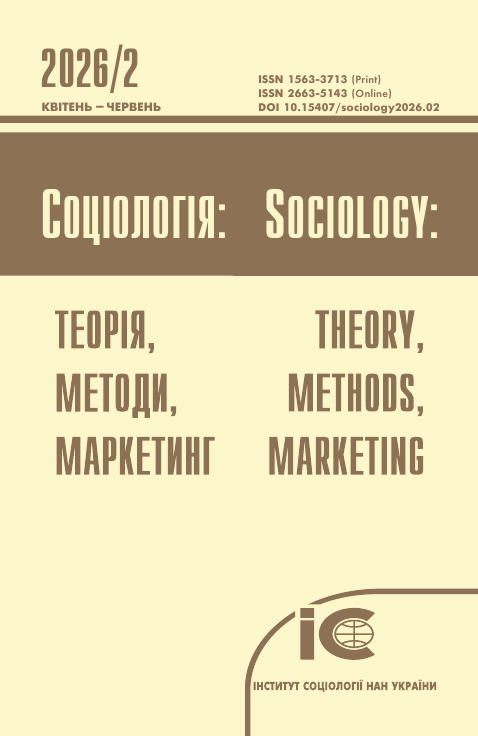
LATEST PRINTED ISSUE
LATEST FREELY ACCESSIBLE MATERIALS
On the war and society in Ukrainian scholarly periodicals in conditions of Russia’s full-scale invasion of Ukraine (2022–2023)
stmm. 2023 (4): 134-155
DOI https://doi.org/10.15407/sociology2023.04.134
Full text: http://stmm.in.ua/archive/ukr/2023-4/10.pdf
OLHA IVASHCHENKO, Candidate of Sciences in Philosophy, Senior Research Fellow at the Department of Social Structures, Institute of Sociology, National Academy of Sciences of Ukraine (12, Shovkovychna St., Kyiv, 01021); Associate Professor at the Department of Social Structures and Social Relations, Faculty of Sociology, Taras Shevchenko National University of Kyiv (4D Academician Hlushkov Ave., Kyiv, 03127)
olgivash@gmail.com
https://orcid.org/0000-0002-7070-2134
The paper presents a selected review of the most valuable thematic publications in Ukrainian journals for social sciences in view of the emergence and exacerbation of social problems owing to the Russian full-scale invasion of Ukraine, such as forced external and internal migration of Ukrainian citizens. A number of related issues are also taken into consideration, such as demographic and gender analysis of displaced persons, prognostic evaluations and social consequences of the greatest migration throughout the post-Soviet history in a comparative perspective. For the first time, special attention is given to the phenomenology of war in sociological and philosophical discourses, as well as to the state and development of Ukrainian sociology during and after the war — with regard to the importance of search for relevant theoretical and methodological approaches, which is shown in articles submitted by both leading and early-career sociologists and philosophers to academic periodicals such as “Ukrainian Society”, “Sociology: Theory, Methods, Marketing”, “Demography and Social Economy”, “Political Studies”, “Philosophical Thought” and “Grani” (“Facets”).
The paper analyses how the journal issues were prepared and thematically shaped — not only in regard to the intellectual reflection of social science at a critical moment in the country’s history but also as a document “mirroring” the state of Ukrainian society in times of an existential crisis. Not all editorial boards were able to cope with such a challenge and promptly respond to the wartime events; however, the majority of leading scholarly periodicals stoically continued their publishing activities, thereby consolidating the research community and communicating their vision and understanding of military topics to broader professional circles and committed citizens. In this context, a special issue of social monitoring by the Institute of Sociology of the National Academy of Sciences of Ukraine deserves particular attention. The issue titled “Ukrainian society in wartime. 2022” is a collective monograph consisting of 38 original articles grouped into seven chapters, which consider various aspects of societal life in wartime in terms of the sociology of emergency, for example socio-psychological and socio-economic problems, socio-structural changes, comparative social dynamics before and during the war, as well as adaptive survival and coping strategies in the crisis-ridden society.
Keywords: sociology of emergency, phenomenology of war, forced migration, survival and coping strategies
References
-
Balakireva, J., Dmytruk, D. (2022). War in Ukraine: perceptions of inhabitants and their nfluence on the quality of life. [In Ukrainian]. Ukrainskyi sotsium, 1(80), 116-122. https://doi.org/10.15407/socium2022.01.116
-
Biriukova, O., Rushchenko, I., Liashenko, N., Grigorieva, S. (2022). Refugees and internally displaced persons of the russian-ukrainian war: Social characteristics and practices. [In Ukrainian]. Grani, 6(25), 143-156.
-
Bondar, T., Haniukov, O. (2023). External migration of Ukrainian before and after full-scale aggression (comparative analysis). [In Ukrainian]. Ukrainskyi soctsium, 1(84), 32-53. https://doi.org/10.15407/socium2023.01.032
-
Bystrytskyi, Ye. (2023). To the ontology of war: Why warfare but not peaseful negotiations. [In Ukrainian]. Philosophical Thought, 2, 74-98. https://doi.org/10.15407/fd2023.02.074
-
Bystrytskyi, Ye., Sytnichenko, L. (2022). Philosophy and discourse of war: Conflict of worlds as the limit of Jurgen Habermas's Communicative Theory. [In Ukrainian]. Philosophical Thought, 3, 64-82. https://doi.org/10.15407/fd2022.03.064
-
Chernysh, N. (2022). Development Specifics of Ukrainian sociology under the Russian-Ukrainian war. [In Ukrainian]. Ukrainskyi sotsium, 4, 9-27. https://doi.org/10.15407/socium2022.04.009
-
Fadeev, V. (2023). Old and new differences: social (re)integration after the war. [In Ukrainian]. Philosophical Thought, 2, 99-116. https://doi.org/10.15407/fd2023.02.099
-
Fylypovych, L., Tytarenko, V., Horkusha, O. (2023). Contextualization as one of the main methodological approaches of religious studies research during the Russian-Ukrainian war. [In Ukrainian]. Philosophical Thought, 1, 7-25. https://doi.org/10.15407/fd2023.01.007
-
Gallup, G. (2022). How important is public opinion in time of war. Sociology: Theory, Methods, Marketing, 4, 173-178.
-
Golovakha, Ye., Makeev, S. (Eds.). (2022). Ukrainian society in the war conditions 2022. [In Ukrainian]. Kyiv: Institute of Sociology, NAS of Ukraine. Retrieved from: https://i-soc.com.ua/assets/files/monitoring/maket-vijna...2022dlya-tipografiivse.pdf.
-
Hnatiuk, V. (2023). "History of migrant": forms of data collection and ways of presenting them in scientific publications. [In Ukrainian]. Political Studies, 1, 123-143. https://doi.org/10.53317/2786-4774-2023-1-7
-
Kalahin, Yu., Shanidze, O. (2023). Gender analysis of social practices of Ukrainian refugees. [In Ukrainian]. Grani, 3(26), 62-68.
-
Khraban, T., Samoilenko, K. (2023). Representations of Servicewomen in the Ukrainian media during the Russian-Ukrainian war. [In Ukrainian]. Ukrainskyi sotsium, 2, 145-167. https://doi.org/10.15407/socium2023.02.145
-
Kolodnyi, A., Fylypovych, L. (2023). Freedom of Religion in Ukraine: Challenges during the Russian-Ukrainian War. [In Ukrainian]. Philosophical Thought, 1, 111-130. https://doi.org/10.15407/fd2023.01.111
-
Kryvda, N. (2022). War in Ukrainian culture: Missionaryness and networking in the structure of horizontal connections. [In Ukrainian]. Philosophical Thought, 3, 125-131.
-
Kudrynska, A., Lapan, T., Khymovych, O. (2022). Military issues: Sociological discourse. [In Ukrainian]. Grani, 5(25), 53-61.
-
Lapan, T., Khymovych, O. (2023)."Social instinct" vs "national self-preservation" as a phenomenon of Ukrainian society during the current Russian-Ukrainian war. [In Ukrainian]. Grani, 2(26), 25-30.
-
Lapan, T., Khymovych, O., Chernysh, N. (2022). The Russian-Ukrainian war: Theory and practice of sociological understanding. [In Ukrainian]. Ukrainskyi sotsium, 3, 28-51. https://doi.org/10.15407/socium2022.03.028
-
Libanova, E., Pozniak, O., & Tsymbal, O. (2022). Scale and consequences of forced migration of the population of Ukraine as a result of armed aggression of the Russian Federation. [In Ukrainian]. Demography and Social Economy, 2(48), 37-57. https://doi.org/10.15407/dse2022.02.037
-
Makeev, S. (2023). Apologetics of culture as an apologetics of war: the case of Werner Sombart. [In Ukrainian]. Sociology: Theory, Methods, Marketing, 1, 42-55. https://doi.org/10.15407/sociology2023.01.042
-
Malysh, L. (2023). EU population's perception of the war in Ukraine. [In Ukrainian]. Sociology: Theory, Methods, Marketing, 1, 10-23. https://doi.org/10.15407/sociology2023.01.010
-
Polіakova, S., Kohatko, Yu. (2023). Poverty of the Ukrainian pensioners: Pre-war situation and influence of the war. [In Ukrainian]. Demography and Social Economy, 2(52), 92-109. https://doi.org/10.15407/dse2023.02.092
-
Reut, A., Kohatko, Yu. (2022). Housing problem in Ukraine on the background of war 2022. [In Ukrainian]. Demography and Social Economy, 3(49), 123-144. https://doi.org/10.15407/dse2022.03.123
-
Rushchenko, I. (2022). The Great Exodus of the Ukrainian people (the phenomenon of displaced persons in 2022). [In Ukrainian]. Ukrainskyi sotsium, 2, 155-168. https://doi.org/10.15407/socium2022.02.155
-
Sliusar, L. (2023). The Ukrainian family in the conditions of war. [In Ukrainian]. Demography and Social Economy, 2(52), 3-20. https://doi.org/10.15407/dse2023.02.003
-
Stehnii, O. (2023). Anthropocentric paradigm of modern warfare. [In Ukrainian]. Sociology: Theory, Methods, Marketing, 1, 24-41. https://doi.org/10.15407/sociology2023.01.024
-
Sztompka, Р. (2023). The bright side of a tragedy: on the unintended and unanticipated consequences of the barbaric aggression. Sociology: Theory, Methods, Marketing, 1, 6-9.
- Yermolenko, A. (2022). Resistance instead of negotiation. [In Ukrainian]. Philosophical Thought, 3, 59-63.
Received 18.09.2023
On the war and society in Ukrainian scholarly periodicals in conditions of Russia’s full-scale invasion of Ukraine (2022–2023)
stmm. 2023 (4): 134-155
DOI https://doi.org/10.15407/sociology2023.04.134
Full text: http://stmm.in.ua/archive/ukr/2023-4/10.pdf
OLHA IVASHCHENKO, Candidate of Sciences in Philosophy, Senior Research Fellow at the Department of Social Structures, Institute of Sociology, National Academy of Sciences of Ukraine (12, Shovkovychna St., Kyiv, 01021); Associate Professor at the Department of Social Structures and Social Relations, Faculty of Sociology, Taras Shevchenko National University of Kyiv (4D Academician Hlushkov Ave., Kyiv, 03127)
olgivash@gmail.com
https://orcid.org/0000-0002-7070-2134
The paper presents a selected review of the most valuable thematic publications in Ukrainian journals for social sciences in view of the emergence and exacerbation of social problems owing to the Russian full-scale invasion of Ukraine, such as forced external and internal migration of Ukrainian citizens. A number of related issues are also taken into consideration, such as demographic and gender analysis of displaced persons, prognostic evaluations and social consequences of the greatest migration throughout the post-Soviet history in a comparative perspective. For the first time, special attention is given to the phenomenology of war in sociological and philosophical discourses, as well as to the state and development of Ukrainian sociology during and after the war — with regard to the importance of search for relevant theoretical and methodological approaches, which is shown in articles submitted by both leading and early-career sociologists and philosophers to academic periodicals such as “Ukrainian Society”, “Sociology: Theory, Methods, Marketing”, “Demography and Social Economy”, “Political Studies”, “Philosophical Thought” and “Grani” (“Facets”).
The paper analyses how the journal issues were prepared and thematically shaped — not only in regard to the intellectual reflection of social science at a critical moment in the country’s history but also as a document “mirroring” the state of Ukrainian society in times of an existential crisis. Not all editorial boards were able to cope with such a challenge and promptly respond to the wartime events; however, the majority of leading scholarly periodicals stoically continued their publishing activities, thereby consolidating the research community and communicating their vision and understanding of military topics to broader professional circles and committed citizens. In this context, a special issue of social monitoring by the Institute of Sociology of the National Academy of Sciences of Ukraine deserves particular attention. The issue titled “Ukrainian society in wartime. 2022” is a collective monograph consisting of 38 original articles grouped into seven chapters, which consider various aspects of societal life in wartime in terms of the sociology of emergency, for example socio-psychological and socio-economic problems, socio-structural changes, comparative social dynamics before and during the war, as well as adaptive survival and coping strategies in the crisis-ridden society.
Keywords: sociology of emergency, phenomenology of war, forced migration, survival and coping strategies
References
-
Balakireva, J., Dmytruk, D. (2022). War in Ukraine: perceptions of inhabitants and their nfluence on the quality of life. [In Ukrainian]. Ukrainskyi sotsium, 1(80), 116-122. https://doi.org/10.15407/socium2022.01.116
-
Biriukova, O., Rushchenko, I., Liashenko, N., Grigorieva, S. (2022). Refugees and internally displaced persons of the russian-ukrainian war: Social characteristics and practices. [In Ukrainian]. Grani, 6(25), 143-156.
-
Bondar, T., Haniukov, O. (2023). External migration of Ukrainian before and after full-scale aggression (comparative analysis). [In Ukrainian]. Ukrainskyi soctsium, 1(84), 32-53. https://doi.org/10.15407/socium2023.01.032
-
Bystrytskyi, Ye. (2023). To the ontology of war: Why warfare but not peaseful negotiations. [In Ukrainian]. Philosophical Thought, 2, 74-98. https://doi.org/10.15407/fd2023.02.074
-
Bystrytskyi, Ye., Sytnichenko, L. (2022). Philosophy and discourse of war: Conflict of worlds as the limit of Jurgen Habermas's Communicative Theory. [In Ukrainian]. Philosophical Thought, 3, 64-82. https://doi.org/10.15407/fd2022.03.064
-
Chernysh, N. (2022). Development Specifics of Ukrainian sociology under the Russian-Ukrainian war. [In Ukrainian]. Ukrainskyi sotsium, 4, 9-27. https://doi.org/10.15407/socium2022.04.009
-
Fadeev, V. (2023). Old and new differences: social (re)integration after the war. [In Ukrainian]. Philosophical Thought, 2, 99-116. https://doi.org/10.15407/fd2023.02.099
-
Fylypovych, L., Tytarenko, V., Horkusha, O. (2023). Contextualization as one of the main methodological approaches of religious studies research during the Russian-Ukrainian war. [In Ukrainian]. Philosophical Thought, 1, 7-25. https://doi.org/10.15407/fd2023.01.007
-
Gallup, G. (2022). How important is public opinion in time of war. Sociology: Theory, Methods, Marketing, 4, 173-178.
-
Golovakha, Ye., Makeev, S. (Eds.). (2022). Ukrainian society in the war conditions 2022. [In Ukrainian]. Kyiv: Institute of Sociology, NAS of Ukraine. Retrieved from: https://i-soc.com.ua/assets/files/monitoring/maket-vijna...2022dlya-tipografiivse.pdf.
-
Hnatiuk, V. (2023). "History of migrant": forms of data collection and ways of presenting them in scientific publications. [In Ukrainian]. Political Studies, 1, 123-143. https://doi.org/10.53317/2786-4774-2023-1-7
-
Kalahin, Yu., Shanidze, O. (2023). Gender analysis of social practices of Ukrainian refugees. [In Ukrainian]. Grani, 3(26), 62-68.
-
Khraban, T., Samoilenko, K. (2023). Representations of Servicewomen in the Ukrainian media during the Russian-Ukrainian war. [In Ukrainian]. Ukrainskyi sotsium, 2, 145-167. https://doi.org/10.15407/socium2023.02.145
-
Kolodnyi, A., Fylypovych, L. (2023). Freedom of Religion in Ukraine: Challenges during the Russian-Ukrainian War. [In Ukrainian]. Philosophical Thought, 1, 111-130. https://doi.org/10.15407/fd2023.01.111
-
Kryvda, N. (2022). War in Ukrainian culture: Missionaryness and networking in the structure of horizontal connections. [In Ukrainian]. Philosophical Thought, 3, 125-131.
-
Kudrynska, A., Lapan, T., Khymovych, O. (2022). Military issues: Sociological discourse. [In Ukrainian]. Grani, 5(25), 53-61.
-
Lapan, T., Khymovych, O. (2023)."Social instinct" vs "national self-preservation" as a phenomenon of Ukrainian society during the current Russian-Ukrainian war. [In Ukrainian]. Grani, 2(26), 25-30.
-
Lapan, T., Khymovych, O., Chernysh, N. (2022). The Russian-Ukrainian war: Theory and practice of sociological understanding. [In Ukrainian]. Ukrainskyi sotsium, 3, 28-51. https://doi.org/10.15407/socium2022.03.028
-
Libanova, E., Pozniak, O., & Tsymbal, O. (2022). Scale and consequences of forced migration of the population of Ukraine as a result of armed aggression of the Russian Federation. [In Ukrainian]. Demography and Social Economy, 2(48), 37-57. https://doi.org/10.15407/dse2022.02.037
-
Makeev, S. (2023). Apologetics of culture as an apologetics of war: the case of Werner Sombart. [In Ukrainian]. Sociology: Theory, Methods, Marketing, 1, 42-55. https://doi.org/10.15407/sociology2023.01.042
-
Malysh, L. (2023). EU population's perception of the war in Ukraine. [In Ukrainian]. Sociology: Theory, Methods, Marketing, 1, 10-23. https://doi.org/10.15407/sociology2023.01.010
-
Polіakova, S., Kohatko, Yu. (2023). Poverty of the Ukrainian pensioners: Pre-war situation and influence of the war. [In Ukrainian]. Demography and Social Economy, 2(52), 92-109. https://doi.org/10.15407/dse2023.02.092
-
Reut, A., Kohatko, Yu. (2022). Housing problem in Ukraine on the background of war 2022. [In Ukrainian]. Demography and Social Economy, 3(49), 123-144. https://doi.org/10.15407/dse2022.03.123
-
Rushchenko, I. (2022). The Great Exodus of the Ukrainian people (the phenomenon of displaced persons in 2022). [In Ukrainian]. Ukrainskyi sotsium, 2, 155-168. https://doi.org/10.15407/socium2022.02.155
-
Sliusar, L. (2023). The Ukrainian family in the conditions of war. [In Ukrainian]. Demography and Social Economy, 2(52), 3-20. https://doi.org/10.15407/dse2023.02.003
-
Stehnii, O. (2023). Anthropocentric paradigm of modern warfare. [In Ukrainian]. Sociology: Theory, Methods, Marketing, 1, 24-41. https://doi.org/10.15407/sociology2023.01.024
-
Sztompka, Р. (2023). The bright side of a tragedy: on the unintended and unanticipated consequences of the barbaric aggression. Sociology: Theory, Methods, Marketing, 1, 6-9.
- Yermolenko, A. (2022). Resistance instead of negotiation. [In Ukrainian]. Philosophical Thought, 3, 59-63.
Received 18.09.2023
LATEST PRINTED ISSUE
LATEST FREELY ACCESSIBLE MATERIALS